
Forget the fairytale homecoming. Welcome to the 90-day probationary period with your new rescue pet. This isn’t a Hallmark movie; it’s a strategic, often messy, and deeply rewarding integration process. We’re not just talking about house-training and chewed slippers. We’re talking about the delicate, cortisol-fueled process of helping a traumatized nervous system learn to feel safe.
Forget the 90-day plan from your corporate job. The real 3-3-3 rule for rescue pets is a biological and behavioral roadmap, not a corporate timeline. It’s the emotional decompression schedule for a creature learning that it’s safely home.
The first three days are a cortisol-soaked blur. Your new family member isn’t being aloof or stubborn—they’re in a state of high-alert survival. Their world just exploded. This isn’t misbehavior; it’s a biological stress response.
The next three weeks are a delicate dance. The real personality isn’t the one you see in the shelter or the first quiet week. It’s the personality that emerges around the three-month mark, once the cortisol fog lifts and they realize the new, terrifying rules of their old life no longer apply.
Think of it as a reverse hostage negotiation. You’re not the captor, you’re the negotiator, using kibble and quiet patience to build a bridge of trust. Statistics on adoption returns often spike in the first three months because we mistake trauma for temperament. This isn’t a pet problem; it’s a nervous system problem. Your job isn’t just to provide a home, but to be the architect of a new, safe reality.
The 3-3-3 Guideline: Your Roadmap, Not a Rulebook
Don’t expect a fairy tale start with your new rescue dog. The journey of trust is messy and non-linear. The 3-3-3 rule is a guide, not a strict plan. It helps a dog adjust to a new world, not a quick fix.
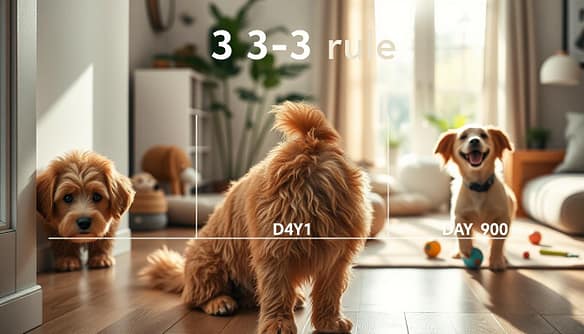
The 3-3-3 rule is a guide, not a to-do list. It shows three phases: the first three days of shock, the first three weeks of adjustment, and the first three months of integration. It’s a path to understanding, not a quick fix.
The first 72 hours are critical. Your dog is in shock, not being stubborn. They need a safe space to adjust. Give them a quiet room with a crate, bed, and water. Let them come to you.
Weeks two to four are about learning. Your dog is exploring and learning about your home. They may forget commands, but it’s part of their learning process. It’s a test of trust.
By the three-month mark, you’ll see your dog’s true self. Research shows behaviors like fear can increase around this time. It’s a sign of progress, not failure. Your dog feels safe enough to show their true self.
By three months, you’re not just meeting a dog. You’re meeting your new partner. The 3-3-3 rule marks the beginning of your real relationship. The journey is just starting, and it’s exciting.
Building a Decompression Routine
Think of your new rescue’s first week as a calm retreat. We’re not training yet; we’re giving their nervous system a break. Your goal for the first 7-10 days is to create a calm, predictable environment.
This isn’t training; it’s a decompression plan. It helps your dog relax and get ready to learn.
Sleep: The Non-Negotiable First Pillar
Forget the “tired dog is a good dog” saying. Dogs who don’t sleep well are like tired toddlers. They can get upset easily and make bad choices.
Many rescue dogs don’t sleep enough. They’re always on edge. Your job is to make a quiet, safe place for them to sleep. Think of it as a “sleep sanctuary.”
A well-rested dog makes better choices. Without sleep, training is hard.
Predictability: The Scaffolding of Security
Sleep is the reset, and predictability is the structure. A chaotic world needs a calm, reliable routine. This isn’t about being strict; it’s about building trust.
Feed, walk, and rest at the same times every day. This isn’t boring; it’s a luxury after a chaotic life.
Enrichment: Brain Games, Not Brawn Games
Enrichment in a decompression plan is about calm activities. We’re not trying to exhaust your dog. The goal is to engage their brain in a calm way.
Think of it as a spa day for their mind. We’re talking about:
- Sniffaris: A 15-minute “sniffy walk” where your dog leads, using their sense of smell.
- Food puzzles and slow feeders that make mealtime a brain game.
- Scatter feeding kibble in a blanket or snuffle mat, using their natural foraging instincts.
This isn’t about physical exhaustion. It’s about calm, rewarding challenges that build confidence.
This decompression plan is not about doing nothing. It’s about doing the right, quiet, predictable things. It’s what your new dog needs to learn, trust, and settle in.
House Training & Confinement Strategies
Forget everything you know about house training a puppy. Your new rescue dog is like a foreign exchange student. They need time to adjust to new customs and language. Accidents and chewing are signs of stress, not defiance.
We need a new approach. This new strategy focuses on “confinement” as a tool, not a punishment. It’s about creating a safe space to prevent mistakes.

Your dog’s world is like a big, confusing office. A crate or safe room makes it smaller and calmer. It’s not a cage, but a sanctuary that prevents bad behaviors.
Why “Confinement” is a Misunderstood Superpower
A rescue dog is overwhelmed by new sights and smells. Confinement acts as a filter, giving them time to process. It stops bad habits like chewing shoes or peeing in the house.
Consistency is key. Stick to a schedule. Out of the crate, straight outside. Treats and praise when they go outside correctly. The crate is for when you can’t watch them.
Building a History of Success
Focus on successes. Every time they go outside correctly, they win. Every crate time without an accident is a win too. You’re building a positive history.
The crate is like their embassy. It’s safe and familiar. It helps them cope with the new world. Use it after meals and naps to prevent accidents.
This isn’t forever. It’s a temporary tool to help them adjust. You’re not just house-training; you’re teaching them your home’s language. You’re building trust and clear communication.
Leash Reactivity & Threshold Management
That first explosive lunge on a walk isn’t a dog being “bad.” It’s a dog screaming ‘I’m terrified and trapped’ through the only language they have left. Welcome to the world of leash reactivity, where that six-foot tether isn’t just a safety line. For a frightened dog, it can feel like a trap.
Forget disobedience. This is a fight-or-flight response on a six-foot lead. When a dog barks, lunges, or freezes at the sight of another dog, a skateboard, or a plastic bag, they’re not being dominant or stubborn. They’re communicating, “I’m terrified of that thing, and I can’t get away.” Your job isn’t to scold the fear out of them. It’s to become a threshold manager.
The single most important concept here is the threshold. Imagine your dog’s stress like a cup. Every stressful sight or sound adds a drop. The threshold is the rim. When the cup overflows, your dog is “over threshold”—barking, lunging, and unable to learn. Our goal in management isn’t to train at this point; it’s to prevent the overflow.
Management is the emergency brake, not the steering wheel. It means creating space (crossing the street, turning a corner), using parked cars or trees as visual barriers, and reading the subtle signs before the explosion. Look for the early whispers of stress your dog shouts before they scream.
The following table breaks down the signs that your dog is approaching their breaking point, and what to do.
| Stress Signal (Subtle) | Over-Threshold Sign (Overt) | Immediate Management Action |
|---|---|---|
| Lip licking, yawning, turning head away | Lunging, barking, growling | Increase distance from trigger immediately. Do not punish. |
| Whale eye (showing the whites of the eyes), stiff posture | Snapping, air-snapping | Use a calm, happy voice. Lure with a treat to turn away. |
| Freezing in place, refusing to move | Spinning, whining, high-pitched barking | Create a visual barrier. Change direction calmly. |
This isn’t about teaching a dog to “ignore” its triggers. It’s a neurological rewiring project. We’re not asking them to ignore the monster; we’re teaching their brain that the appearance of a trigger predicts something wonderful from you—a counter-conditioning project. When they see a trigger at a safe distance (below threshold), a high-value treat appears. The brain begins to rewire: “Dog on horizon = chicken appears from sky!” This is slow, patient work that cannot start until you can manage the environment to keep your dog under their threshold.
Think of it like this: you can’t teach someone to swim while they’re drowning. First, you pull them to safety (management). Then, you teach them to swim (behavior modification). Leash reactivity is not a training problem to be solved on the fly during a reactive episode. It’s a process of building new, positive associations where fear once lived.
Resource Guarding: Prevention & Safety Plans
When your rescue dog guards their new chew toy like Fort Knox, it’s not a personal betrayal. It’s economics. This isn’t a moral failure in your dog’s character. It’s a survival script, written in the language of scarcity.
When that new, safe life you’ve built feels real around the three-month mark, that’s when a dog’s true self emerges. And sometimes, that true self really, really likes its stuff.
Think of it this way: in the high-stakes economy of a shelter or a life of uncertainty, a bone isn’t just a treat. It’s a scarce asset. Resource guarding isn’t greed; it’s a rational, if outdated, business plan for survival. Your dog isn’t being “bad.” They’re running the only economic model they’ve ever known: scarcity. Our job isn’t to punish the strategy, but to build a better economy.
The goal isn’t to “cure” the instinct to guard. You can’t negotiate a dog out of a survival instinct. The goal is management and a new economic policy. We build a safety plan, not a battle plan. This means creating a “safety plan” that works for everyone.
Your first move is the “no trespassing” rule. When your dog has a high-value item, make it a human-free zone. No reaching, no hovering. This isn’t a power struggle; it’s a boundary. You’re not stealing their treasure; you’re respecting their economic bubble while you build a new system of trade.
The core of your safety plan is the trade-up game. This is where you rewrite the economic rules. The old economy was: “Scarce resource + potentially threat = guard it.” The new economy is: “Human hand = better stuff.” Start with low-value items and boring treats. Offer a piece of chicken for that dry kibble. The message? Giving something up is the start of a great deal.
This is where “drop it” and “leave it” become your most valuable commands. They’re not just party tricks. They are the fiscal policy of your new economy. You’re not just teaching a cue; you’re proving that compliance with you is the most profitable option on the market.
For the high-value items—the rawhide that looks like the crown jewels—management is key. A safety plan might mean your dog enjoys that special bone in their crate or a designated “no-go” zone. This isn’t banishment. It’s creating a predictable, low-stress economy of one. Over time, the need for the “high-security” zone fades as the new, more prosperous economy takes hold.
In the end, managing resource guarding isn’t about dominance or showing who’s boss. It’s economic policy. You’re not a dictator; you’re a benevolent central banker, introducing a new, more prosperous currency: your attention, your treats, your partnership. You’re not taking things away; you’re showing a better deal.
Separation Anxiety Basics & Alone-Time Training
Let’s get something straight: what’s called “separation anxiety” is actually a panic disorder. Your dog isn’t acting out when you leave; they’re having a real panic attack. The whining, pacing, soiling, and destroyed door frames aren’t defiance. They’re desperate signs of a creature convinced its world has ended.
Studies on rescue dogs show panic peaks around three months. This is when a new bond is forming. As a dog’s attachment grows, so does the fear of being left behind. Their panic is as real and physical as yours. The first rule is tough: stop making a big deal of arrivals and departures. Treat your comings and goings like a librarian reshelving books. No dramatic goodbyes or hellos.
The training is all about patience. You’re not “curing” anxiety with a puzzle toy. You’re teaching them that when you leave, you’re not gone for good. This is done through micro-absences. We’re talking seconds, not minutes or hours.
The process is simple but slow. You leave the room for 5 seconds, then return calmly. You do this until it’s boring. Then you go for 10 seconds, then 20. You even step outside for 3 seconds. You’re not building tolerance; you’re creating a new neural pathway that says, “They leave, and they always come back.” The Kong or chew is just a distraction to keep their brain busy.
Forget the dramatic goodbyes and reunions. You’re now part of a play where the script is boredom. The goal is to make your departures and arrivals so routine that your dog’s panic switch never gets flipped. This is the hard work of building security from scratch.
Selecting a Force-Free Trainer: Your Dog’s Therapist, Not a Drill Sergeant
Choosing a force-free trainer is like hiring a therapist for your dog. The term “dog trainer” is not regulated, so anyone can call themselves one. But a good trainer is more than that. They are a translator, a coach, and a detective all in one.
Start by looking at their resume. Look for certified trainers with credentials like the CPDT-KA or KPA CTP. These show they’ve studied and use humane methods.
Ask the trainer about their methods first, not the price. A true force-free training expert will talk about learning theory and positive reinforcement. They should ask about your dog’s history and your goals.
Think of it like choosing a mechanic. You wouldn’t want one who only uses a hammer. A good trainer will teach you how to communicate with your dog, making you the expert.
Here’s a quick guide to help you understand the different certifications:
| Credential | Governing Body | What It Means | Why It Matters |
|---|---|---|---|
| CPDT-KA or CPDT-KSA | Certification Council for Professional Dog Trainers (CCPDT) | Rigorous, proctored exam; requires continuing education. KSA (Knowledge & Skills Assessed) includes a practical skills assessment. | The gold standard for certified trainers; ensures a broad knowledge of learning theory and humane practices. |
| KPA CTP | Karen Pryor Academy | An intensive, hands-on program focused on positive reinforcement and marker-based training. | Graduates are highly skilled in using clickers and positive reinforcement for complex behaviors. |
| IAABC Member | International Association of Animal Behavior Consultants | Requires a combination of education, experience, and a commitment to a strict code of ethics. | Ideal for complex behavior cases; members are often experts in fear, anxiety, and aggression. |
Your first meeting should feel like a team effort, not a sales pitch. A force-free training professional will want to know about your dog’s history and fears. They should explain their plan clearly and without jargon. If they promise quick fixes or use harsh tools, it’s time to leave. You’re looking for a translator, not a drill sergeant. Choose someone who listens and teaches you to build trust with your dog.
Red Flags: When to See a Vet or Veterinary Behaviorist
That endearing quirk where your rescue dog growls over a bone might be communication, but an unprovoked snap is a different language entirely. Your rescue dog’s behavior exists on a spectrum. Knowing when “quirky” ends and “clinical” begins is key.
Think of your rescue dog’s behavior as a complex algorithm. Some outputs are features, others are bugs. A growl over a bone is your dog communicating a boundary. An unprovoked, sudden snap with no discernible trigger? That’s the system throwing an error code that needs professional debugging.
The Quirk-Red Flag Spectrum
Let’s decode the difference. Your dog humping the sofa cushion isn’t quirky – it’s a red flag. The same goes for resource guarding that escalates beyond a warning growl. Recent studies show nearly 30% of shelter returns are due to unrealistic expectations.
When Training Becomes Clinical
That line between training and clinical intervention is where many owners get stuck. Ask yourself:
- Is the behavior escalating despite consistent training?
- Does the behavior pose a danger to people, other animals, or the dog itself?
- Has the behavior severely diminished your or your dog’s quality of life?
If you answered yes to any of these, you’ve crossed from the training zone into clinical territory. This isn’t a failure – it’s data. Your dog isn’t being “bad” – they’re communicating distress in the only language they have.
Quirks vs. Red Flags: A Practical Guide
| Quirks (Usually Training) | Red Flags (Professional Help Needed) |
|---|---|
| Growling when approached while eating | Unprovoked aggression toward people or animals |
| Pulling on leash during walks | Self-mutilation or obsessive behaviors |
| Mild separation anxiety (whining when alone) | Destructive behavior when alone |
| Normal puppy mouthing | Biting that breaks skin or leaves marks |
The Professional Spectrum: Who to Call
Here’s where many owners get lost. A veterinary behaviorist is like an animal psychiatrist. They’re veterinarians with additional board certification in behavior. They can prescribe medication if needed. A certified applied animal behaviorist has a PhD in animal behavior but isn’t a vet. The difference matters when medication might be part of the treatment plan.
Think of it this way: if your dog’s behavior were a car problem, a trainer is your mechanic for routine maintenance. A certified behaviorist is your master mechanic, and a veterinary behaviorist is the specialist who can also prescribe the right fuel additives (medication) when needed.
When to Escalate
The data on pet returns reveals a harsh truth: many dogs are returned not because of their behavior, but because of owner expectations. A growl over a bone isn’t aggression – it’s communication. But a sudden, unprovoked snap? That’s your red flag waving. When behavior crosses from “this is challenging” to “this is dangerous or severely diminishing quality of life,” you need a professional who can differentiate between a training issue, a medical issue (pain often manifests as aggression), or a deeper behavioral pathology.
Remember that study on returns? The unrealistic expectation that rescue dogs come as finished products, not projects, fuels many relinquishments. A veterinary behaviorist or certified applied animal behaviorist provides that objective assessment: training issue, medical issue, or clinical behavioral pathology. Your rescue dog deserves that clarity – and so do you.
Bottom line: When your gut says “this isn’t normal,” trust it. That’s not you failing as a pet parent – it’s you being a responsible advocate for a dog who might be communicating pain, fear, or a neurological issue that training alone can’t fix.
Case Study: From Overwhelmed to Settled – A Timeline
Getting a rescue dog like Milo isn’t a fairy tale. It’s a journey of small victories. Milo, a mix of many rescue dogs, didn’t follow a script. His path from a scared shelter dog to a settled friend is a lesson in the 3-3-3 rule.
Days 1-3: The “Shutdown” Phase
Milo wasn’t the loving dog his new family expected when he first arrived. He hid, didn’t eat, and had an accident. This was his decompression period, not about bonding but safety. We kept his environment safe, giving him food and water without pressure.
Weeks 1-3: The “Testing” Phase
As Milo’s fear lessened, his confidence and mischief grew. He stole a sock and counter-surfed. These actions showed he felt safe enough to explore. This phase is key for managing expectations. We didn’t punish but managed his environment and started a decompression routine.
Month 2: New Challenges, New Data
New “problems” appeared as a routine formed. Milo lunged at dogs on walks. This leash reactivity wasn’t aggression but insecurity. We managed his environment, crossing streets and creating distance to keep him calm.
Month 3: The Nuances of Trust
By month three, Milo showed resource guarding by growling over a slipper. This wasn’t bad behavior but a sign of trust. We started a safety and training plan without punishment. The 3-3-3 rule was in action, showing us his “worst” to fix it.
This timeline shows progress, not problems. Milo was struggling, not being difficult. Each issue was a step on his adjustment journey. The 3-3-3 rule guided us, but Milo’s journey filled in the details. Patience is key in rescue, not just a virtue.
Local R+ Trainers & Behavior Clinics
Finding the right dog trainer can be tough. It’s not just about who’s cheap or close by. You need someone who truly understands your dog.
A certified trainer is a good start. They have credentials from places like the Certification Council for Professional Dog Trainers (CCPDT). They help with basic training and behavior issues. Think of them as the mechanics for your dog’s behavior.
For serious problems like fear or aggression, you need a veterinary behaviorist. They are vets who specialize in behavior. A certified trainer is great for basics, but a vet is needed for deeper issues.
To find the best, look at professional organizations. The CCPDT and IAABC have lists of certified trainers who use force-free, science-based methods. It’s like choosing a chef with a degree over a home cook.
When talking to a trainer, it should feel like a serious conversation. Ask about their philosophy and experience with rescue dogs. A good trainer will explain why they use certain methods and understand your dog’s background.
The right certified trainer does more than teach tricks. They help you understand your dog. It’s about finding someone who can connect with your dog’s unique story.
Advocate Action Steps
Your role in the first 90 days is not to be perfect. Instead, be patient and consistent. Think of yourself as a translator for a being from a strange world. You need a specific plan for this role.
First, adjust your expectations to match reality. Many people think a dog will settle quickly. But, the rescue dog’s first 90 days are about rewiring their brain, not just learning commands. Being patient is key.
Second, defend your dog in public. Strangers and family members may push for too much. You need to protect your dog’s space and time. Keep a simple log to track patterns, not to control every detail.
Third, gather a support team. Find a vet and a trainer you trust, and connect with other adopters. This is not a solo effort. As Don Sawyer’s piece on listening before leading shows, understanding the situation first is essential.
The first 90 days are not about perfect training. It’s about making your dog feel safe. Trust comes first, then training. You’re not just giving a home; you’re providing a safe, patient, and observant presence.