
You’ve seen a shadow in the alley. You’ve noticed eyes glowing under a dumpster. We call them strays, ferals, and alley cats.
Meet Coeur de Pirate, a one-eyed cat who loved wand toys and cozy beds. His story shows that “home” can mean different things. It’s not just a place; it’s a feeling.
Community cats live in outdoor colonies, managed by TNVR (Trap-Neuter-Vaccinate-Return). The main goal is to control their numbers. But the real magic is when they find a home.
This journey from the outdoors to being a indoor companion is fascinating. It’s about cats finding trust and love. For every Coeur de Pirate, there’s a story of slow socialization and trust.
Groups like alley cat advocates show that sterilization is just the start. The end is a heartwarming Pet Adoption Success. It’s one of the most inspiring TNR to adoption stories out there.
Community Cats 101: TNR, SNR, and adoption pathways
Let’s look at the facts behind Trap-Neuter-Vaccinate-Return. It’s like the Linux kernel for community cat programs—open, efficient, and straightforward. The process is simple: trap, sterilize, vaccinate, ear-tip, and return. This last step is key.
The “R” in TNR means return, not abandonment. It’s about bringing a cat back to its territory. Now, it’s a non-breeding, vaccinated resident. Its ear-tip signals to others, “I’m fixed.”
This method isn’t new. It started in 1950s Britain. Jacksonville, Florida, was the first in the US to use it. They saw a big drop in shelter intake and euthanasia.
Now, let’s talk about the critics. They usually bring up three points: birds, rabies, and nuisance complaints.
First, birds. Cats do hunt, but studies show habitat loss is the bigger threat. Sterilized cats might hunt less. TNR reduces the number of future hunters.
Second, rabies. Every cat in a TNVR program gets vaccinated. This is a win for public health. A stable, vaccinated colony stops disease spread.
Third, nuisance complaints. Yowling, fighting, and spraying are mating behaviors. Sterilization cuts these behaviors by 90%. It’s simple cause and effect.
The alternative is trap-and-kill. It’s like trying to hold water with a sieve. It’s expensive, endless, and questionable. TNVR, on the other hand, has clear data supporting it.
| Aspect | Trap-Neuter-Vaccinate-Return (TNVR) | Trap-and-Kill (Traditional Control) |
|---|---|---|
| Primary Goal | Stabilize & humanely reduce population over time. | Immediate, temporary reduction in numbers. |
| Cost Efficiency | High long-term ROI; stops reproduction at the source. | Low ROI; cycle repeats indefinitely, incurring repeated costs. |
| Public Health | Creates a barrier of vaccinated animals. | Leaves territory open to unvaccinated newcomers. |
| Nuisance Behaviors | Drastically reduces yowling, fighting, spraying. | May temporarily reduce, but behaviors return with new cats. |
| Public Support | Garners volunteer and donor support. | Often faces public opposition and controversy. |
Within this strategy, there’s a special case: TNR to adoption stories. Some cats aren’t meant for the colony. They show signs they want a different life.
These cats are the SNR (Shelter-Neuter-Return) or direct adoptions. They move from the alley to the armchair. This shows why community cat programs are complex. They’re about more than just managing cats.
So, before we get to the heartwarming stories, remember the basics. TNVR isn’t just kinder. It’s smarter economics and public health. It’s the foundation that makes those TNR to adoption stories possible.
4 Stories: from colony life to indoor companions
Forget the stereotype of the uniformly wild street cat. The reality is a complex social fabric. Each cat on the block carries a unique history, written in whisker twitches and tail flicks.
Successfully navigating a cat from alley to armchair means learning to read that file. It requires understanding there is no one-size-fits-all solution, only a spectrum of possibilities. Let’s meet four classic profiles from the feline underground.
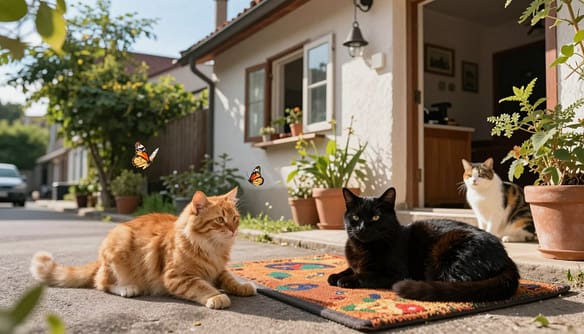
The Veteran. This is the old soldier of the colony, like the famed Coeur de Pirate. Years of outdoor survival have etched a tough exterior. But a medical crisis—a wound, an illness—can reveal the gentle soul hiding beneath the armor.
Once safe indoors, the veteran often sheds its street-wise persona with surprising speed. The fight-or-flight software gets a major update. What emerges is a cat yearning for safety, quiet, and a soft place to land. They didn’t choose the street life; they endured it.
The Friendly Stray. This cat is the porch cat diplomat. It rubs against legs during feedings and might even meow a greeting. This isn’t a feral cat; it’s a displaced house pet. Its social software is already fully installed and operational.
Reintegration is less about training and more about providing a stable address. These socialized street cats are the low-hanging fruit of rescue, already primed for a return to domestic life. They just need a door held open.
The Feral Kitten. Here lies the blank slate, captured young enough for its wild source code to be gently rewritten. Unlike the veteran, it has no deep-seated trauma of street battles. Unlike the friendly stray, it doesn’t remember a home.
This is pure socialization. With patience, play, and positive reinforcement, its fundamental programming about humans shifts from “threat” to “source of good things.” It’s the most malleable of the archetypes.
The Content Colony Guardian. Not every story ends on a sofa. This cat is perfectly adapted to its outdoor kingdom. A dedicated colony caregiver provides food, shelter, and medical care through TNR.
But this guardian chooses the open sky. It is the watchful presence, the established member of a managed colony. The caregiver respects this choice, understanding that for this cat, freedom is the ultimate comfort. This relationship redefines success.
These four narratives illustrate the vast spectrum of socialized street cats. The journey from colony life isn’t a single path. It’s a menu of possibilities, from full indoor adoption to supported outdoor living.
The key is that individual dossier. Is the cat a veteran, a stray, a kitten, or a guardian? The answer, provided by observant colony caregivers and rescuers, dictates the only roadmap that matters: the cat’s own.
Socialization Playbook: kittens vs adults, feeder/foster teamwork
Welcome to the diplomacy phase. Your goal is to make a tiny, self-governing entity see your sofa as better than a storm drain. This isn’t obedience school. It’s a slow, strategic campaign for trust. The playbook splits into two distinct volumes: one for kittens, one for adults.
Think of it this way. Kitten socialization is a relatively straightforward software update. If applied during the critical developmental window (roughly 2 to 7 weeks), it usually takes. Exposure to gentle handling, play, and human voices can wire them for domestic life in a matter of weeks.
Adult feral socialization, on the other hand, is a root-level system rewrite. Their worldview is set. Your job isn’t to install new code, but to patiently convince the existing system that your source is safe. This requires a different, more nuanced protocol.
The success of this feline détente often hinges on a beautiful, unspoken pact between two key roles: the colony caregiver and the foster. The caregiver builds trust on neutral ground—the alley, the porch. The foster provides the secure embassy (a spare room, a large crate) where deeper negotiations happen.
| Aspect | Kitten Socialization | Adult Feral Socialization |
|---|---|---|
| Core Analogy | Software Update | Operating System Overhaul |
| Critical Window | 2-7 weeks old | Ongoing; no “window” |
| Primary Method | Positive exposure & handling | Routine, patience, & choice-based interaction |
| Pace & Expectations | Weeks; often leads to full adoption | Months to years; goal may be “socialized enough” vs. fully tame |
| Human Role | Fun, safe novelty | Predictable, non-threatening resource |
For kittens, the process is immersive. Bring them indoors to a safe, confined space. Handle them gently multiple times a day. Associate your presence with food and play. They adapt quickly.
With adults, start outdoors. The colony caregiver’s most powerful tool is silent presence. Sit quietly during feeding times, letting the cat eat at a distance. Over days or weeks, decrease that distance inch by inch. Never force contact.
When moving an adult indoors, the “safe room” is non-negotiable. A quiet bathroom or spare bedroom with hiding spots allows the cat to observe you on their terms. Use mealtimes as your primary interaction. Sit with them, talk softly, but let them initiate any proximity.
Tools of the trade? Wand toys are excellent for building positive associations without the threat of direct touch. A carrier left in the safe room becomes a secure cave, not just a scary travel box. The routine is everything—feed at the same time, visit at the same time. You are building predictability in a world that has been chaotic.
The critical decision, often made by the primary colony caregivers, is evaluating the end goal. For some adults, a “socialized enough” status—where they are comfortable receiving food and basic care on a porch or in a sheltered colony—is a monumental success. A permanent, safe outdoor enclave might be the best diplomatic solution.
This is where the teamwork shines. The feeder provides the initial intelligence and trust. The foster executes the intensive indoor protocol. Communication between them about the cat’s body language and progress is the intelligence briefing that guides the entire mission. It’s a partnership that turns a lone alley cat into a candidate for a different kind of life.
Health Considerations: FIV/FeLV, vaccines, parasite control
Let’s talk about the serious side of community cat programs. It’s where feelings meet facts, and the “V” in TNVR really matters. Skipping this part is like building a bridge without checking for termites.
First, we need to talk about vaccines. Rabies is a must for public health. Then, there’s the FVRCP combo to protect against serious diseases. These shots are essential for any cat, whether it’s staying with you or living in a colony.
FIV and FeLV tests can seem scary. But, they’re not always a death sentence. FIV is rare in everyday contact, and many cats with it live long, healthy lives. FeLV is more contagious but can also have good outcomes. A positive test means we need to care for the cat better, not give up on it.
Parasites like fleas and worms are also a big deal. They can make cats sick and spread diseases. A good parasite control protocol is key for a cat’s health and the health of its community.
This careful health planning makes a community cat program truly effective. It’s not just about fixing a cat; it’s about giving it a better life. You’re not just fixing a cat; you’re upgrading its entire operating system.
Learn more about what “no-kill” really means and how it works in shelters at this link.
Building Bridges: neighbor mediation, caretakers, shelter partnerships
The real work of community cat programs starts after trapping. It’s about fixing human problems.
No cat or its feeder is alone. The biggest challenge is the people around them.
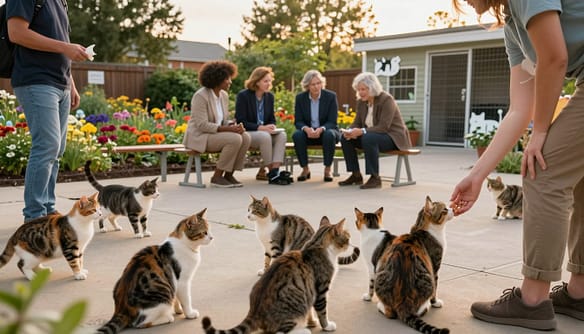
How do you talk to a neighbor who sees cats as a problem? You don’t argue. You show them facts.
In Harrington, Delaware, a TNR program made a big difference. Complaints about cats fell by 98%. This shows the power of facts over feelings.
Share that data. Explain how fixed cats fight less and make less noise. You’re not asking for tolerance. You’re promising a quieter neighborhood.
Colony caregivers need legal protection. They face a strange problem. They might be seen as the cats’ owners, making them responsible for any issues.
So, it’s key to push for good local laws. Laws that clearly say caregivers aren’t owners. They protect those who help the cats.
Building a strong relationship with your local animal shelter is also vital. The old way of dealing with stray cats is outdated. We need to work together.
Take Jacksonville’s “Feral Freedom” program as an example. The shelter works with NGOs to help cats. This way, cats get the care they need, and shelters save resources.
At its heart, community cat programs are about people skills. They need facts, legal protection, and teamwork with shelters.
By building these bridges, you do more than manage a cat colony. You change a community for the better.
How to Help Locally: trapping teams, foster networks, supply drives
Let’s cut the inspirational montage. Local change isn’t about a lone hero; it’s about finding your specific socket in the community machine. You’ve read the TNR to adoption stories; now, where’s your toolbelt?
The ecosystem thrives on three interdependent roles. Are you the Logistician, the Negotiator, the Nurturer, or the Quartermaster? Each is a critical node.
The Logistician: Trapping Teams & Transport. This is a logistical ballet of borrowed traps, coordinated schedules, and clinic runs. Your first move isn’t buying gear. Reach out to local TNR groups or shelters; most have trap libraries. Your job is coordination—mapping colonies, scheduling volunteers, and playing chauffeur for spay/neuter appointments. The negotiator’s parallel task is securing those low-cost vet slots. It’s less about heroics and more about being a reliable pivot in the operation.
Staying informed about organized animal care systems across different fields can also strengthen community programs. Resources like professional equestrian updates often highlight structured coordination, welfare standards, and management practices that can inspire more efficient local rescue and volunteer operations.
The Nurturer: Foster Networks. This is where macro strategy meets micro-care, for the vulnerable. Fostering is feline witness protection, giving safety, food, and that all-important kitten socialization. Adult ferals may only need a quiet recovery room post-surgery. But kittens? Their window for becoming adoptable companions is narrow. Foster networks provide the manpower. You don’t need a mansion. A spare bathroom and patience are the primary currencies. This phase is the critical bridge in any TNR to adoption stories.
The Quartermaster: Supply Drives. Every army marches on its stomach, and community cat care runs on kibble, blankets, and carriers. Your role is procurement and distribution. Organize a drive at your office, place a donation bin at a local business, or leverage Amazon Wish Lists for a group. You’re the supply sergeant, ensuring trappers have equipment and fosters aren’t paying for formula out-of-pocket.
Your Starter Kit for Engagement:
- Find the Network: Search “[Your City] TNR coalition” or “community cat rescue” on social media. Attend one meeting. Listen first.
- The Introductory Call: Don’t lead with “I want to save all the cats.” Say, “I have [X hours] a week and can drive/coordinate supplies/foster kittens. What’s your most pressing need?”
- Avoid Burnout: Define your lane. The logistician isn’t also the 24/7 foster. The quartermaster isn’t solo-trapping. Sustainable help is specialized help.
This is how abstract compassion becomes block-by-block infrastructure. Your niche contribution—whether securing a vet discount, socializing a litter, or storing donated food—directly fuels the local pipeline. The grand narrative of change is just the sum of these small, smart, operational choices.
Conclusion: Every Block Can Be a Safety Net
The journey from alley to home is a team effort. It’s not just a dream but a plan for a better community. We aim to find a place for every cat, whether it’s in a managed colony or a cozy spot by a window.
Numbers show the truth. Lifeline for Pets saved nine cats in 2020. A Black Friday event saw a 78% increase in adoptions. And during National Void Appreciation Week, adoption rates soared by 62%. These aren’t random events. They are Pet Adoption Successes thanks to good policies and community involvement.
Every success story has a face. Blanca went from being underweight to healthy. Whitney, turned down twelve times, found her forever home. These socialized street cats show that looks or abilities don’t limit a cat’s future. Their stories, shared in places like the All About Pets Show, prove they can be happy and healthy.
So, what’s the bottom line? The safety net is made of good info, feeding programs, and shelters working together. When it succeeds, it makes our neighborhoods better. The real question is, what kind of community do we want to build?