
The Kentucky Derby is known for its glamour, with mint juleps and fancy hats. But there’s a less shiny side. Many Thoroughbreds face an uncertain future after their racing days end.
Rescue operations like Hidden Acres show a harsh truth. These fast horses need special care after racing. But who helps them when the cheering stops?
Teenagers are stepping up to help. These young volunteers do more than clean stalls. They learn responsibility and care for retired racehorses at horse rescue youth programs.
Groups like DEFHR turn barn work into leadership training. It’s where kids learn about caring for animals. This way, the track’s loss becomes a community’s gain.
Youth Program Overview at Rescue Facilities
Think of youth programs at equine rescues as different colleges within the same university. Each facility crafts its own curriculum in compassion. They all share the same core mission: transforming both horse and human.
The architecture of these initiatives reveals a fascinating ecosystem. Here, teen animal advocacy meets practical education.
Let’s tour the campus, shall we? At DEFHR (Dreaming of an Equine Future Horse Rescue), the model is the classic volunteer powerhouse. Their philosophy is beautifully simple: welcome all ages and abilities. Whether you’re eight or eighteen, physically able or navigating challenges, there’s a stall to muck or a horse to groom.
This isn’t babysitting; it’s boot camp for empathy. The program structure is fluid, allowing volunteers to grow from basic chores to managing adoption events. It’s the liberal arts approach to rescue work—broad, inclusive, and foundational.
Then there’s the BHH (Brave Hearts Haven) model, which operates more like a graduate school for emotional intelligence. Their tiered system—Regular, Advanced, Seasonal—functions as a ladder of responsibility. Regular volunteers learn basic equine care. Advanced participants dive into training techniques and rehabilitation. Seasonal programs offer intensive immersion.
The focus here is less on labor and more on the symbiotic healing between scared horses and anxious teens. It’s therapeutic, almost sage-like in its approach to building resilience.
Hidden Acres Rescue represents the specialized technical college. Their entire operation revolves around the specific mission of rehabilitating off-track Thoroughbreds. Every volunteer, regardless of age, is trained in their meticulous quarantine and rehab process.
This isn’t general horse care; it’s targeted medicine for athletes in crisis. The curriculum is rigorous, mission-driven, and produces specialists in racehorse transition.
Choosing a program becomes a question of educational fit. Are you looking for the broad volunteer experience of DEFHR, the therapeutic ladder of BHH, or the specialized focus of Hidden Acres? Each develops teen animal advocacy through a different pedagogical lens.
The entry points for these programs are as varied as the models themselves. Many start through student community service requirements for school. It’s the classic gateway: earn credit while doing good. But what begins as a mandatory hour log often evolves into a passion.
From there, paths diverge. Some facilities offer free ongoing volunteering. Others have structured, fee-based advanced lessons for those who want to deepen their horsemanship skills.
This ecosystem creates a beautiful meritocracy of compassion. A 14-year-old might start mucking stalls for student community service credit. By 16, they could be assisting with veterinary care. By 18, they might help interview adopters.
The progression isn’t about age; it’s about demonstrated responsibility and growing empathy. The barn becomes a classroom where the syllabus is written in hay, sweat, and gentle whispers to nervous animals.
Ultimately, these programs understand that effective teen animal advocacy requires structure. It’s not enough to love horses. You need to understand their trauma, their physiology, their psychology. The best programs provide that framework while leaving room for the unstructured magic that happens when a teenager and a rescued horse connect. It’s education with heartbeat.
Meet Sarah, 16: Mucking Stalls to Managing Adoptions
Sarah started at a horse rescue facility with dreams of horse care. She thought it was all about brushing manes and going on trail rides. But, she quickly learned it was much harder.
Her first task was cleaning stalls. It was a big change from her expectations. This is where horse rescue youth programs show who’s really committed.
But Sarah found out that cleaning stalls was important. It taught her about horse health and how to read their signs. She was learning fast, while her friends were watching videos.
Soon, Sarah moved on to preparing food for the horses. She learned about different diets and medications. She started keeping detailed records, which was a big responsibility.
Then, Sarah got to give a tour to a family interested in adopting a horse named Bella. She explained Bella’s needs and history. This was her first big success.
After that, Sarah became more involved. She helped with adoption paperwork and even social media. She was making a real difference in the lives of horses and people.
Here’s how Sarah’s role grew over time:
| Time Period | Primary Responsibilities | Skills Developed | Impact Level |
|---|---|---|---|
| Weeks 1-4 | Stall cleaning, basic grooming, water bucket refills | Observation, physical stamina, routine establishment | Direct horse care |
| Months 2-3 | Feed preparation, medication assistance, daily health logs | Attention to detail, record-keeping, nutritional knowledge | Health monitoring |
| Months 4-6 | Adoption tours, client communication, social media updates | Public speaking, marketing, interpersonal skills | Program advocacy |
| Month 6+ | Adoption coordination, volunteer training, event planning | Leadership, project management, mentorship | Program growth |
Sarah’s story shows that age doesn’t matter. She’s a 16-year-old who’s making a big impact. She’s learned that trust comes from hard work, not just a badge.
What’s amazing is that Sarah wasn’t always into horses. She started because her friend wanted to help. Now, she can spot health issues and explain medical history. These programs teach more than just horse care. They build strong, capable people.
Her journey shows the power of giving young people real responsibility. They will surprise you with their growth. The hard work in the stalls and feed room paid off. She’s now a leader among her peers.
Today, Sarah leads a team of teen volunteers. She’s the go-to person for adopters. She’s earned her place through hard work and dedication.
These horse rescue youth programs teach valuable lessons. It’s not about titles. It’s about building a reputation through hard work. Sarah’s transformation shows that it’s possible to grow and learn in real-world situations.
Jake’s Story: From Scared of Horses to Lead Trainer
Jake faced a big fear: 1,200 pounds of nervous ex-racehorse. He started with a “ten-foot pole” approach, keeping a safe distance. This was ironic, given his role at a horse rescue.
Marie’s story about Afka, a skittish thoroughbred, inspired Jake. He saw her as a fellow anxious soul. Her approach, the BHH model, was all about understanding the horse’s body, heart, and head.
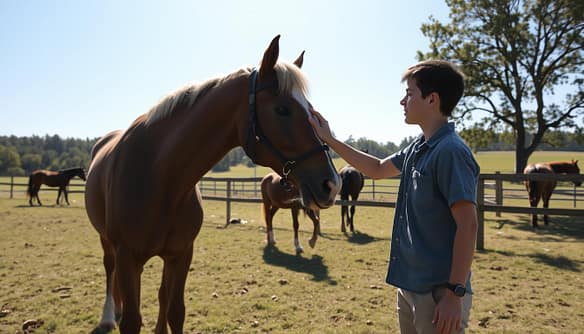
Building confidence wasn’t about grand gestures. It was about small, steady steps. Jake started by standing in the same paddock. Then, he held a lead rope while someone else worked.
Then, a new horse named Jasper arrived. Jake was given the chance to work with him. He used the BHH model, mirroring Marie’s techniques.
Jake’s calm and focus surprised everyone. He didn’t try to bond magically with Jasper. Instead, he observed Jasper’s fear, using it to understand him better.
Soon, Jake wasn’t just following rules; he was teaching others. He became the lead trainer for the most nervous horses. His journey from fear to leadership was remarkable.
This form of student community service changes lives. It doesn’t just build resumes; it builds self-confidence. Jake’s story shows how working with animals can turn anxiety into a tool for connection.
Programs like the Jacob project focus on more than just cleaning stalls. They help young people overcome their fears. Jake’s journey shows that working with animals can be a powerful way to learn about emotional intelligence and grit.
The Leadership Development Through Horse Care
The most valuable MBA in resource management I’ve seen wasn’t in a classroom. It was in a 15-year-old cleaning a water trough at a rescue. This shows what horse rescue youth programs teach.
Forget corporate retreats and trust-fall exercises. Real leadership training happens in places with hay and determination. Every task here is a lesson. Cleaning that trough teaches about supply chain, maintenance, and the importance of detail.
Then, there’s the herd, a study in group psychology. Watching young volunteers learn equine body language is like learning non-verbal leadership. They see how the alpha mare leads without a sound. Leadership isn’t about being loud; it’s about being calm and consistent.
Data shows teens build confidence through competence, not pep talks. With horses, you can’t fake it. Your leadership is either real, or it’s ignored. This builds “authentic confidence,” earned through real actions.
Teaching others is magic when an experienced teen shows a newcomer how to halter safely. They must break down tasks into steps and communicate clearly. If they fail, someone could get hurt.
Compare this to traditional “leadership camps.” Those are simulations. Here, the stakes are real, and feedback is immediate and honest. A horse doesn’t care about your feelings. It responds to your skill, clarity, and emotional control.
| Leadership Dimension | Traditional Leadership Camp | Horse Rescue Youth Program |
|---|---|---|
| Primary Skills Focus | Public speaking, team exercises, theoretical models | Resource management, non-verbal communication, situational awareness |
| Learning Environment | Controlled, artificial scenarios | Unpredictable, living system with real consequences |
| Feedback Mechanism | Peer reviews, facilitator notes | Immediate, non-verbal feedback from the animal |
| Cost & Accessibility | Often expensive, exclusive | Typically low-cost or volunteer-based, community-focused |
| Long-term Application | Resume bullet points | Muscle memory for patience, crisis calm, and earned respect |
The table above isn’t meant to dismiss all traditional programs. But it highlights why horse rescue youth programs create resilient leaders. They face challenges no seminar can replicate. Is the horse having a bad day? Did the weather change its mood? Is there a new animal causing tension?
Young volunteers learn to adapt in real-time. They develop “situational leadership.” They adjust their approach based on the individual and the moment. This isn’t abstract theory. It’s the difference between a horse cooperating or refusing to load into a trailer.
Ultimately, these programs teach that leadership is service. The most respected teen isn’t the one giving orders from the fence. It’s the one in the stall at 7 AM, ensuring each animal has what it needs to thrive. That’s a lesson no corporate seminar can match. It’s leadership, distilled to its essence: responsibility for another living being.
The confidence built here is unshakable. It’s not based on empty praise. It’s based on proven capability. When you’ve managed a recovering racehorse, group projects and deadlines feel manageable. You’ve already handled pressure that matters.
Parent Testimonials and Family Impact
Parents share stories of healing and skill-building through student community service. The barn is a place where families can find peace, even without words. It’s a space for heavy emotions to be shared.
Kristy’s daughter found solace after a tough loss. Words were hard to find. But the horses helped her be herself. The routine of caring for them gave her structure. The horses listened without judgment, teaching her about quiet presence.
Becky Daniels’ story shows how skills gained at Beyond the Homestretch helped her daughter. Her daughter’s FFA project won fourth place at a state pig show. It shows these programs are more than just fun. They build real skills.
Student community service becomes a family bond. It’s not just about grades. It’s about shared pride and purpose. Teens come home with stories of success, like a nervous horse taking a treat.
| Area of Impact | Parent Testimonial Evidence | Long-term Family Benefit |
|---|---|---|
| Emotional & Mental Well-being | Providing a non-verbal, therapeutic outlet for processing grief or stress (Kristy’s story). | Creates a more stable, communicative home environment; reduces parental anxiety. |
| Practical Skill Development | Animal care skills directly applying to academic/FFA projects (Becky’s story). | Fosters independence, problem-solving, and provides tangible family achievements. |
| Shared Family Identity | Conversations shifting from daily friction to the shared mission of animal welfare. | Builds a stronger family narrative centered on compassion and service. |
| Community Connection | Families often become donors, advocates, or volunteers themselves. | Expands the family’s social network and roots them in local, meaningful causes. |
Parent testimonials show the real impact of these programs. They heal families and build character. It’s a priceless investment in family life.
Skills Gained: Responsibility and Empathy
Forget those ‘leadership seminars’ in sterile conference rooms; the real curriculum for responsibility and empathy is taught in muddy paddocks. Here, the stakes aren’t hypothetical case studies. They’re a 1,200-pound former athlete whose well-being literally depends on your follow-through.
This isn’t responsibility as chore charts or showing up on time. This is stakes-based learning where failure has tangible consequences. Forget to check the water trough? That’s not a missed checkbox. It’s a dehydrated animal. Skip the evening feed? That’s hunger pangs in a creature who can’t order takeout.
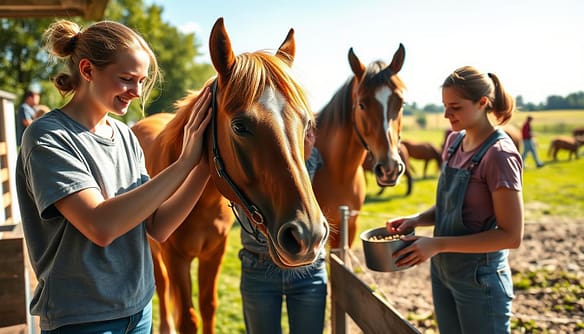
For young volunteers, this framework rewires their understanding of duty. The lesson is brutal in its simplicity: another being’s comfort, health, and trust are in your hands. It’s accountability with teeth.
Now, let’s talk empathy. We’ve diluted the word into meaning “being nice.” At a horse rescue youth program, empathy is a practiced, observable skill. It’s reading the flick of an ear, the tension in a neck, the swish of a tail. A pinned ear isn’t just an ear—it’s a boundary. A lowered head isn’t just posture—it’s relaxation or defeat.
Teenagers learn to become translators of non-verbal communication. This is where it gets fascinating. The neural pathways fired while interpreting equine anxiety are the same ones used to read human emotional cues. That volunteer learning to approach a skittish Thoroughbred is, without realizing it, taking a masterclass in trauma-informed care.
Many rescued racehorses carry invisible baggage—anxiety from loud crowds, fear from past injuries, trust issues from abrupt ownership changes. Sound familiar? Young volunteers become adept at recognizing triggers and giving calm, consistent presence. This skill set translates directly to social work, teaching, healthcare, and any profession dealing with people.
The Sage in me must point out the obvious: we’ve been outsourcing emotional intelligence training to the wrong places. The best empathy gym might just have a riding arena and smell faintly of hay.
| Skill Area | Horse Rescue Application | Traditional Youth Activity Equivalent | Real-World Translation |
|---|---|---|---|
| Responsibility | Daily care ensures a living creature’s health and safety. | Completing homework or household chores. | Project management where outcomes affect people’s welfare. |
| Empathy & Emotional IQ | Reading subtle equine body language to assess mood and need. | Team sports communication or group project collaboration. | Client relations, counseling, and leadership requiring emotional attunement. |
| Trauma-Informed Approach | Working patiently with animals who have experienced neglect or injury. | Volunteering at a community shelter or food bank. | Careers in social services, education, or healthcare with vulnerable populations. |
| Non-Verbal Communication | Understanding that a horse’s posture and eyes communicate more than sounds. | Learning a new language or musical instrument. | Cross-cultural communication, negotiation, and interpreting unspoken workplace dynamics. |
So when we talk about horse rescue youth programs, we’re not just discussing animal welfare. We’re analyzing a sophisticated human development platform. It takes abstract virtues—responsibility, empathy—and grounds them in the immediate, physical world.
The transformation witnessed in young volunteers isn’t magical. It’s neurological. It’s the brain learning that attention to detail matters because a life depends on it. It’s the heart learning to decipher silent stories told through another being’s eyes. That’s an education no classroom can replicate.
College Application Benefits
Let’s be honest: every parent and grade-obsessed teen wants to know how shoveling manure translates to Ivy League acceptance. The answer lies not in the task itself, but in the story you tell about it.
Admissions officers read thousands of essays about building houses abroad or tutoring elementary students. Your experience with teen animal advocacy at a horse rescue stands out like a thoroughbred at a pony show. It’s student community service with teeth—and hooves.
The magic happens in translation. “Mucked stalls” becomes “managed sustainable waste-cycling operations for a large-animal residential facility.” “Fed horses” transforms into “oversaw nutritional protocols for recovering equine athletes.” This isn’t deception—it’s framing. You actually did these things, with real responsibility and consequences.
Colleges crave narratives of growth. Your journey from nervous newcomer to confident caretaker provides that arc. It shows initiative beyond checking boxes. Sustained commitment to a horse rescue youth program demonstrates maturity that weekend volunteers can’t match.
For aspiring veterinarians or animal scientists, this experience is pure gold. You’re not just volunteering—you’re conducting field studies in equine behavior, nonprofit logistics, and applied ethics. You’ve seen the healthcare system from the ground up, literally.
Here’s how to frame it for applications:
- Essay Material: Focus on one transformative moment. Maybe the first time a scared horse trusted you, or when you helped with a difficult adoption.
- Activity List: Use action verbs. “Coordinated,” “managed,” “developed” instead of “helped with.” Quantify when possible: “Assisted with care for 15+ rescued equines.”
- Recommendations: Ask your program supervisor. They can speak to your growth in ways teachers cannot.
This experience proves you can handle responsibility beyond academics. You’ve managed living creatures, worked in teams under stress, and understood complex operational systems. That’s what selective colleges actually want—not just good students, but interesting humans.
In the competitive theater of college admissions, your teen animal advocacy work isn’t just another line item. It’s a compelling subplot in your personal narrative. It shows specialized knowledge, emotional intelligence, and grit. While others write about what they did, you can write about what you learned—and how it changed you.
That’s the real benefit. You’re not just building a resume. You’re building character, and admissions officers can smell authenticity a mile away. Or, in this case, they can recognize someone who isn’t afraid to get their hands dirty for a cause they believe in.
Starting Youth Programs at Your Local Rescue
Finding a real horse rescue takes more effort than picking a new show. But the rewards for young volunteers are huge. It’s not just about finding cute horses. It’s about finding places where your help really makes a difference.
First, you need to do some research. Stay away from rescues that focus too much on social media. Real rescues care more about the horses than their online image. Look for places that are open about their finances, have clear adoption rules, and focus on helping the horses.
When you approach a rescue, be clear about what you can offer. Don’t just show up looking for fun. Rescue leaders are often overwhelmed by people who don’t really understand what they do. Show them you’re serious by talking about what skills you can bring, even if it’s just being organized.
Most horse rescue youth programs have a specific way of getting started. Learn about these different approaches:
- The Formal Application (BHH Model): Some rescues, like the one in our case study, use structured online applications. This filters for genuine commitment. Treat it like a college essay—highlight your reliability, not just your love for animals.
- The Orientation Gateway (DEFHR Model): Attend a mandatory information session first. This isn’t bureaucracy; it’s a litmus test. It separates the casually curious from future dedicated young volunteers.
- The Soft Entry (Hidden Acres Model): Start with donations, attend an open house, or take a tour. This builds relationship capital. It shows you respect their operational flow before asking for a role.
Remember, start small. Don’t try to take on too much too soon. Offer to help with simple tasks like cleaning stalls. It may not be glamorous, but it shows you’re serious about helping.
This initial humility is key. By doing the hard work, you prove your worth. You’re not just filling a spot; you’re showing you’re ready for more.
Think of it as starting a partnership. Your goal is to move from just being interested to actively helping. The steps are clear: research well, approach with professionalism, be willing to work hard, and let your effort speak for itself. The right rescue will give you a chance to grow and learn.
The journey from interested teen to key young volunteer is intentional. Find a rescue that matches your values and be ready to contribute from the start. The horses and your future will benefit greatly.
Success Metrics and Long-term Outcomes
How do you measure a rescue’s success? It’s clear: horses fixed, horses found new homes. But the real success is in the people.
Studies show teens grow a lot. They stay in school longer. Their college apps stand out because of student community service.
They also feel less anxious. This is because they learn to care for others.
Becky Daniels’ story shows the real impact. Graduates don’t just leave. They come back. They help others, like “Sarahs” and “Jakes.”
The goal is more than just saving horses. It’s about raising a generation that cares naturally. We aim to make compassion a part of everyone’s life.
Here’s the amazing part. Rescued horses help teenagers. Those teens grow up to help others. It’s a cycle of kindness.
The best measure? Seeing a scared kid and a broken horse heal together. Then, years later, that kid teaches another. This is how we change the world, one person at a time.