
Forget the clichés. You’re not just getting a pet; you’re planning a heist. The target? A heart. The loot? Unconditional love and a lifetime of hair on your black pants. The pet adoption process is less like a simple transaction and more like a heist movie, and you need a good plan.
This isn’t a story about “saving” a pet. It’s a guide to the strategic, emotional, and wonderfully messy process of bringing a rescue into your life. We’re moving beyond the “adopt, don’t shop” bumper sticker to analyze the actual journey.
Think of it as a heist film. There’s the initial spark of the idea (the plan), the reconnaissance of local shelters (casing the joint), the heart-pounding meet-and-greet (the meet-cute, or the meet-bark), and the final, glorious getaway to your home (the post-credits scene where the team celebrates).
But every great heist needs a solid blueprint. This guide is that blueprint. We’ll dissect the emotional and logistical journey from the first “maybe we should get a dog” thought to the moment your new co-pilot pees on your rug for the first time. We’ll talk about shelter visits, paperwork, and the moment you realize that you are the one who has been rescued.
So, let’s walk through the adoption process, from that first flicker of an idea to the “gotcha day” and the beautiful, chaotic life that follows.
Why Adopt: The Impact and Ethics of Your Choice
In today’s world, we check where our coffee and clothes come from. Yet, we often don’t think about where our pets come from. Your decision to adopt, shop, or breed is a big deal. It affects more than just your home.
Adopting a pet is more than saving an animal. It’s a way to challenge the big pet industry. When you adopt, you’re taking money away from breeders and pet stores. It’s a quiet way to make a difference.
The Overpopulation Equation: More Than Just a “Shelter Pet” Problem
Every year, 3-4 million animals are euthanized in U.S. shelters. It’s a bigger issue than just shelters. Commercial breeders and puppy mills create too many animals for profit. Shelters are left to deal with the overflow.
Choosing adoption is more than getting a pet. It’s saying no to the demand that fuels the problem. It’s a choice to support the solution, not the issue.
Buying a puppy from a breeder while a shelter pet dies is not neutral. It supports the system that causes overpopulation. You’re either part of the problem or the solution.
The Economic Calculus of a Second Chance
Adoption is not just about ethics; it’s also practical. Shelter pets are often spayed/neutered, vaccinated, and microchipped. The adoption fee helps rescue more animals.
Adopting is also a smart financial move. Purebred puppies can be expensive and may have health problems. Shelter pets are often healthier and come with a vet’s health history.
The Unseen Ripple Effect of Your Choice
Your choice has a big impact. Adopting from a shelter or rescue does three important things:
- It saves a life. This is the most direct and immediate impact.
- It creates space. Your adoption opens a kennel for the next animal in need.
- It funds the rescue ecosystem. Your adoption fee helps fund the rescue of the next animal.
Adopting is a cycle of kindness. It changes one life and helps the whole rescue system. Your choice to adopt is powerful.
Adopting a pet is not just a kind act. It’s a smart, ethical choice. You’re voting for a world where compassion matters. That’s the real impact of your choice.
Choosing the Right Organization
So you’ve decided to adopt. Now, you’re wondering where to find your new pet. The world of animal welfare is diverse, with different types of organizations. It’s not just about picking a pet; it’s about finding the right type of partner for your adoption journey.
Your choice affects your experience, support, and the animal you bring home. It’s like choosing a university for your future furry scholar. Each organization has its own pros and cons.
The Municipal or County Shelter: The Public Service Powerhouse
The municipal shelter is like the public hospital or ER for animals. They take in everything that comes in. This is where you find urgent cases.
The vibe is high-stakes and fast-paced. You might find your soulmate quickly. But, you might know less about the animal’s past and get less support after adoption.
The Nonprofit or Foster-Based Rescue: The Agile Startup
This is the agile, mission-driven tech startup of the animal world. Foster-based rescues are like a decentralized network of caregivers. Animals live in homes, not kennels.
The process is rigorous, with multiple references and home checks. But, you get a pet whose personality is well-known, and you often get great support after adoption. The wait might be longer, but the match is often more precise.
The Breed-Specific or Sanctuary Rescue: The Specialists
These are the specialists. Breed-specific rescues know all about a breed’s quirks and needs. Sanctuaries are long-term care facilities for animals with special needs.
Adopting from a sanctuary means providing a forever home to an animal with special needs. It’s a deeper kind of commitment.
Here’s a quick guide to the shelter vs rescue landscape:
| Organization Type | Best For Adopters Who… | Typical Process | Ideal Adopter Profile |
|---|---|---|---|
| Municipal/County Shelter | Want a streamlined process, are flexible on breed/age, and are ready to provide a home quickly. | Often same-day or within 24-48 hours. Less intensive screening. | The decisive, ready-to-go adopter who trusts their gut. |
| Nonprofit/Foster-Based Rescue | Value a known personality, want post-adoption support, and don’t mind a thorough vetting process. | Can take weeks. Involves applications, references, home checks, and interviews. | The prepared planner who wants a deep background on their pet. |
| Breed-Specific Rescue | Have their heart set on a specific breed and want breed-savvy support. | Lengthy and specific; they often have waitlists for popular breeds. | The dedicated enthusiast who has done their breed research. |
| Sanctuary or Special-Needs Rescue | Seek a deeply meaningful, patient-focused adoption and have resources for special care. | Extensive, with a focus on the adopter’s ability to provide specialized care. | The compassionate, experienced owner ready for a unique commitment. |
Your choice between a shelter and a rescue is a philosophical and practical one. Shelters are like emergency rooms, while rescues are like long-term rehab centers. Both are vital in their own ways.
The shelter vs rescue decision is about what kind of adopter you are and the journey you want. Are you the swift, decisive first responder, or the patient, research-oriented planner? Your answer will guide you to the right place.
Self-Assessment: Lifestyle, Species/Breed, and the Energy/Energy Equation
Before you fall for those puppy-dog eyes, let’s conduct a lifestyle audit more thorough than your last relationship post-mortem. This isn’t about whether you want a pet—it’s about whether your life can sustain one. Think of it as a compatibility test where the only right answer is brutal honesty about your daily reality, not your aspirational Instagram feed.
This is where the real work begins. Forget breed aesthetics or the viral TikTok of a dancing poodle. We’re matching energy, not just aesthetics. Are you a “The Office” re-run, sweatpants-on-the-couch person, or a “weekend warrior” training for a half-marathon? Your pet’s energy needs to sync with your daily output, or you’ll both be miserable.
The Lifestyle Audit: Your Honest-to-Goodness Reality Check
Start with a time audit. Track your week. How many hours are you actually home? If your schedule is more “The Wolf of Wall Street” than “The Joy of Painting,” a high-maintenance breed will test your sanity. Consider your space with the critical eye of a real estate agent. That 500-square-foot studio might be a studio for you, but it’s a cage for a Border Collie.
Be honest about your financial bandwidth, too. The adoption fee is just the cover charge. Factor in food, vet bills, pet insurance, and the inevitable “new leather couch” you’ll need after your new cat decides it’s a perfect scratching post.
The Energy Equation: It’s Not You, It’s Physics
This is the core of the “how to adopt a dog” or “how to adopt a cat” question. Energy is the currency of pet ownership. A high-energy dog in a low-energy home is a recipe for chewed furniture and canine angst. A sedate, older cat will be miserable with a toddler who sees it as a furry, pull-string toy.
Ask yourself: Are you a lazy Sunday philosopher or a 5 a.m. trail runner? Your pet’s energy must match, or at least complement, your household’s baseline hum. This isn’t about good or bad—it’s about fit. A high-energy herding dog will redecorate your home with your favorite shoes if you’re a 9-to-5 desk jockey.
| Pet Profile | Ideal Human Counterpart | Energy Level Match | Best For Lifestyle | Consider Before Adopting |
|---|---|---|---|---|
| High-Energy Working Dog (e.g., Border Collie, Australian Shepherd) | The Weekend Warrior. You run, hike, or have a job that gets you moving for 2+ hours a day. | Extremely High. Needs 2+ hours of vigorous activity. | Active singles/couples, rural/suburban homes with yards. | Boredom leads to destruction. Not for apartment dwellers or the sedentary. |
| Low-Energy Dog (e.g., Basset Hound, Bulldog) | The Homebody. Enjoys long naps, short walks, and the couch is your throne. | Low to Moderate. Happy with a few short walks and mental games. | Apartment dwellers, less active households, first-time owners. | Prone to weight gain and joint issues; diet and short, regular walks are key. |
| Adult Cat (Domestic Shorthair Mix) | The Independent Professional. You value companionship but need your own space. | Moderate. Playful bursts, but 16-hour naps are sacred. | Apartment-friendly, good for 9-5 workers with moderate space. | Requires environmental enrichment (cat trees, window perches). |
| Small Mammal (Rabbit, Guinea Pig) | The Urban Dweller. Limited on space but high on affection. | Low to Moderate. Social, needs daily handling but lower space needs. | First-time pet owners, families with young kids (with supervision), small homes. | Social animals; often better in pairs. Habitat and diet are specific and critical. |
The table above isn’t just a chart; it’s a mirror. It forces the question: Am I this person? If the answer isn’t a resounding “yes,” you’re not just adopting a pet; you’re adopting a lifestyle you’re not equipped to live.
The Breed (or Species) Question
Once you’ve done the energy math, consider the species and breed. Research isn’t just Googling “cute dog breeds.” It’s understanding that a Siberian Husky in Miami is a recipe for misery, or that a vocal Beagle in a thin-walled apartment is a one-way ticket to eviction. Shelters are full of “surrendered for behavior” pets that were simply mismatched from day one.
When you think about how to adopt a cat, it’s not just “cat.” A rambunctious Bengal needs a different home than a 10-year-old lap cat. The same logic applies when considering how to adopt a dog—a Border Collie is a PhD candidate; a Bulldog is more of a community college student who’s already aced “Relaxation 101.”
This self-audit isn’t meant to discourage. It’s the opposite. It’s the foundation for a successful, lifelong match. It’s the difference between a pet that feels like a chore and a companion that feels like family. Do the math on your life, then find the pet whose equation matches yours.
The Application: References, Landlord Letters, and Policy Decoding
Think of the adoption application as a way to show your values. It’s like a test to see if you’re ready for a new pet. They’re looking for someone who is responsible and understands the rescue’s mission.

Every question on the adoption application is important. It’s not just about filling in the blanks. You need to tell a story of stability and commitment.
The Reference Check: Your Network is Your Net Worth
References are not just for your mom. They’re checking if you’re a responsible and caring person. They want to see if your community thinks you’re stable and compassionate.
What They’re Really Asking With References:
- Stability Over Time: Long-term friends or colleagues show you can keep relationships strong.
- Responsibility: A vet reference is more than just proof of pet ownership. It shows your long-term commitment.
- Community Ties: A reference from a neighbor or local business owner can be more powerful than a corporate CEO.
The Landlord Letter: The Permission Slip for a Shared Life
This is not just a formality. For renters, the landlord permission is key. It protects against the worst-case scenario of having to return a pet.
Policy Decoding: The Fine Print That’s Not So Fine
Adoption contracts are serious. They’re not just suggestions. The spay/neuter clause helps control overpopulation. Home visits check for safety and compatibility.
Think of the adoption application as a movie. You’re the lead actor, and the rescue is the director. They want to make a great movie, not a disaster. Your job is to be ready and show you can handle the role.
Screening & Home Checks: What They’re Really Looking For
Let’s get real: the term “home check” might make you think of a strict inspector. But, it’s not about judging your cleaning skills. It’s about checking for safety risks. Think of them as a guardian for a curious, accident-prone pet.
So, what do they really look for? They’re on the lookout for dangers. It’s not about your home’s look; it’s about keeping your pet safe.
The Real Checklist: It’s Not About the Dust Bunnies
Forget about the dirty dishes. The inspector is focused on safety. Here’s what they check:
- Toxic Hazards: They look for dangerous plants, chemicals, and wires. These are big no-nos for pets.
- Escape Routes & Fort Knox Failures: They check if your fence is secure. They want to make sure your pet can’t escape.
- Unsecured Hazards: They watch out for unstable furniture and objects. Safety is key, not neatness.
- Household Harmony: They also check the atmosphere. They want to see if your home is calm and peaceful.
How to Ace Your Home Check: The Proactive Approach
Don’t just wait for them to judge. Take charge and show them your home’s safety. Here’s how:
- Pre-Check Sweep: Do a safety check yourself. Secure loose items and hide dangerous plants.
- Be the Tour Guide: Show them around. Highlight the safe areas and where your pet’s essentials will be.
- Ask Questions: Ask about your pet’s needs. This shows you’re thinking ahead and willing to adapt.
The home check is not a test of cleanliness. It’s a joint effort to ensure your home is safe for your new pet. It’s about showing your home is a safe space for your pet’s new life.
The All-Important Meet-and-Greet: Reading Body Language & Pet Introductions
Forget the awkward first date. This isn’t a meet-cute. The meet-and-greet between your pet and a new family member is like a high-stakes diplomatic summit. It’s about checking if they can get along, not forcing friendship.
Every twitch, yawn, and tail flick is a message in a language you need to understand. It’s like trying to read a secret code.
Think of it as the first UN summit between two very different cultures. Your job is to translate and moderate. The goal isn’t to make them best friends right away. It’s to make sure there’s no immediate conflict.
The first few minutes are a delicate dance of postures, gestures, and averted gazes. These actions speak volumes.
The Diplomatic Corps: Decoding the Non-Verbal Lexicon
Forget the tail wag. That’s the amateur’s mistake. Real communication happens in the micro-expressions: the flick of an ear, the tension in the shoulders, the slight curl of a lip. You, the human diplomat, must become fluent in this silent language.
The Canine Cipher: Wags, Whales, and Wrinkles
Dogs are open books if you know the alphabet. A high, stiff tail is a flag of alertness or anxiety, not just happiness. The classic “play bow” (front down, rear up) is a formal invitation to parlay.
The real tells are subtler. The “whale eye”—when a dog shows the whites of its eyes while looking away—is a sign of significant stress, not curiosity. A lip lick or a yawn when not tired are classic canine “calming signals,” a request for a time-out in the conversation. A dog that turns its head away or offers a play bow is a diplomat seeking a peaceful resolution.
Feline Diplomacy: The Art of the Slow Blink
Cats are the master cryptographers of body language. A slow, deliberate blink is a feline peace treaty. A slow, gently swishing tail can signal interest, while a rapid, thumping tail is a “cease and desist” order.
A cat that approaches with a softly twitching tail held high is a truce. Hissing isn’t a declaration of war; it’s a firm but clear statement of a non-negotiable boundary.
The Protocol of Introduction: A Step-by-Step Summit
This isn’t a free-for-all. Structure is your peace treaty.
- The Neutral Zone: Start in a neutral, scent-neutralized space. Your living room isn’t neutral. A quiet, outdoor space or a large, unfamiliar room is the Switzerland for this negotiation.
- The Controlled Approach: Keep both animals on-leash or behind barriers initially. Let them observe, sniff the air, and process each other’s chemical “credentials.”
- Parallel Play: Engage in parallel activities—like a walk in the same park, but with ample distance. This allows for shared experiences without direct confrontation.
- Observe, Don’t Intervene: Your role is translator and safety monitor, not a cheerleader. Watch for the subtle signs: a play bow, a sniff, a relaxed posture. Interrupt only if you see signs of genuine fear or aggression.
As the data from experienced fosters suggests, trust their assessment. The foster parent has seen this animal in a home environment. If they advise that a particular pet does best with slow, staged introductions, or that a certain pet is not a fit for a home with a dominant resident dog, listen. They’ve seen the animal’s true diplomatic style, not just its best behavior.
This meet-and-greet isn’t about love at first sight. It’s a scouting mission. You’re not looking for fireworks; you’re looking for a lack of landmines. A successful first summit doesn’t guarantee a perfect union, but it establishes a protocol for peaceful, if not immediately friendly, coexistence. The goal of this first diplomatic mission is a simple one: to ensure that the only declarations made are for more treats and a longer walk, not for a hasty retreat.
Contracts, Fees, and the Paper Trail: What You’re Actually Signing (and Paying For)
After meeting and finding your perfect pet, you face a final step: the contract and fee. This isn’t just a financial deal. It’s the moment you officially welcome your new pet into your life. You’ll also get a detailed receipt for the services that made your pet ready for adoption.
The Contract: More Than a Signature, It’s a Social Contract
Don’t just quickly sign the adoption agreement. It’s not just legal stuff; it’s a promise. You promise to care for your pet, provide vet visits, and a safe home. The shelter or rescue promises the pet is healthy, spayed/neutered, and vaccinated.
This agreement is about more than just adopting a pet. It’s about the values you share for your pet’s well-being for life.
The Fee Breakdown: An MBA-Worthy Case Study in Value
The adoption fee might seem high, but it’s not a price tag. It’s a small part of the cost for services that would cost much more if you paid for them separately. Let’s look at what the fee covers:
| Service | Retail Value | Covered by Fee |
|---|---|---|
| Spay/Neuter Surgery | $200 – $600 | ✓ |
| Core Vaccinations (DHLPP, Rabies, etc.) | $75 – $150 | ✓ |
| Microchip Implantation & Registration | $45 – $75 | ✓ |
| Flea/Tick & Deworming Treatment | $25 – $75 | ✓ |
| Initial Vet Exam & Health Check | $50 – $100 | ✓ |
| Adoption Fee (Average) | $50 – $400 | |
When you see the breakdown, the $300 adoption fee looks like a great deal. It covers over $800 in services. It’s not just a purchase; it’s a big investment in a new life.
The Microchip: A Permanent, Silent Guardian
The fee also includes a microchip, a tiny, high-tech ID. This isn’t just tech; it’s a permanent ID for your pet. If your pet gets lost, a simple scan can find your contact info, helping to bring them home quickly.
So, when you sign the contract and pay the fee, you’re not just buying a pet. You’re helping the shelter rescue more animals. The paperwork is just the beginning of your journey together.
Gotcha Day & The First 72 Hours: The Decompression Blueprint
Think of your new pet as a high-strung, four-legged defector from a foreign land, and your home as the decompression chamber. Gotcha Day isn’t just a celebration; it’s the start of a high-stakes, three-day initiation ritual. Forget the confetti and party hats. The first 72 hours are a critical systems integration period, not a welcome party.
Your mission, should you choose to accept it, is to provide a secure, low-pressure environment. This is where your new companion can decompress from the shelter or foster environment. It’s a strategic, patient operation.
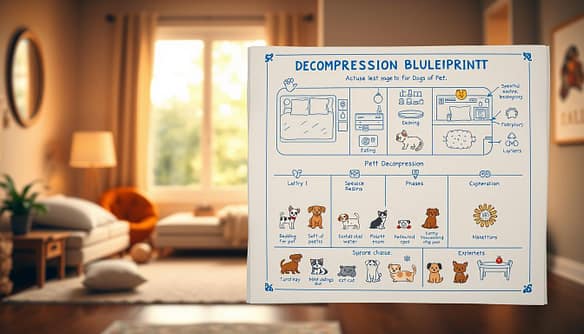
The Decompression Chamber: Your Home as a Safe Zone
Imagine you’ve just been air-dropped into a foreign country where you don’t speak the language or know the customs. That’s your new pet’s reality. The first 72 hours are less about bonding and more about providing a stable, low-stimulation environment.
Your home should function as a decompression chamber, a neutral zone where the only pressure is the atmospheric kind. This isn’t the time for a house tour or a meet-and-greet with the entire extended family. It’s about creating a quiet, predictable environment.
Think of it as the pet’s “onboarding” period—less like a party and more like a quiet first day at a new job where you’re just trying to find the coffee machine.
The 3-3-3 Rule: A Phased Approach to Unwinding
This is where the 3-3-3 rule becomes your decompression blueprint. It’s not a marketing gimmick; it’s a behavioral roadmap for a creature in a state of high-alert transition.
| Phase | Timeline | Pet’s Likely State | Your Role |
|---|---|---|---|
| First 3 Days | 0-72 Hours | Overwhelmed, fearful, may not eat or drink much. Hiding, no accidents. | Decompression Officer. Provide a quiet, safe space (like a single room). Limit interaction. Don’t force contact. |
| First 3 Weeks | Days 4-21 | Starting to settle, testing boundaries, personality emerges. | Confidence Builder. Establish routine. Begin basic training. |
| First 3 Months | Months 1-3 | Feeling at home. True personality emerges. | Integrator. Deepen bond, solidify training, become a true family. |
During the initial 72-hour decompression phase, your new pet is running a diagnostic on its new environment. They’re not giving you the cold shoulder; they’re running system checks. A cat hiding under the bed for two days isn’t a rejection; it’s a strategic retreat.
A dog that won’t leave its crate isn’t being stubborn; it’s fortifying its forward operating base. Your job is to be the calm, consistent, and predictable force in this new, chaotic world.
The 72-Hour Blueprint: Your Action Plan
Your first 72-hour blueprint is simple: do less. Resist the urge to smother with affection. Provide a designated safe space (a quiet room for a cat, a crate or pen for a dog) with all necessities. Let them come to you.
This isn’t a test of love at first sight; it’s a trust fall. Offer food and water, but don’t hover. Ignore the impulse to “make them comfortable” with constant attention. Let the new dynamic unfold at their pace.
This controlled, low-stimulus approach isn’t neglect—it’s the foundation of a secure, long-term bond. Remember, you’re not just adopting a pet; you’re onboarding a new family member with a complex, unknown history. The first 72 hours set the tone for that entire relationship.
The First 30-90 Days: Routine, Vet Visits, and Building Trust
The first 72 hours with your new pet are like the opening scene of a heist movie—all adrenaline, quick decisions, and a touch of controlled chaos. You’ve made it through the “Gotcha Day” whirlwind. Now, you exit the frantic crisis management of the first 72 hours and enter the project management phase. This is where the real work—and the real magic—happens. The next 30 to 90 days are a strategic operation to build a life together. Think of it as moving from the “honeymoon phase” into the “building a shared Google Calendar” phase. It’s where you trade crisis management for strategic planning, and where trust is built one kibble, one walk, and one quiet evening on the couch at a time.
The 3-3-3 Rule in Practice: Your New Roadmap
Forget complex training manuals. The most useful guide for the first 90 days is the simple, powerful 3-3-3 Rule. It’s the project timeline for your new family member’s emotional and behavioral decompression. Don’t think of it as a countdown to a “normal” pet; think of it as a phased, compassionate onboarding process.
| Phase | Timeline | What’s Happening | Your Focus |
|---|---|---|---|
| First 3 Days | Days 1-3 | The “Decompression & Observation” phase. Your pet is overwhelmed. They may hide, be silent, not eat much, or test boundaries. It’s a major system reboot. | Provide a safe, quiet space. Don’t force interaction. Keep the environment calm and predictable. This is not the time for a house party introduction to all your friends. |
| First 3 Weeks | Weeks 1-3 | The “Settling In” phase. Your pet starts to realize this isn’t a temporary stop. They’ll test rules, explore more, and their true personality (and perhaps some behavioral quirks) begins to emerge. | Establish the basic routine (feeding, walks, potty breaks). Start basic, reward-based training. Begin to gently enforce household rules. The first vet visit should happen here. |
| First 3 Months | Months 1-3 | The “Building a Bond” phase. Your pet starts to feel secure. They learn the household rhythms, their personality blossoms, and a true bond of trust begins to solidify. | This is where deep trust is built. You can start more advanced training, socialize them appropriately, and they start to see your home and family as their permanent safe haven. |
This isn’t a rigid schedule, but a map. Some pets will rocket through the first 3 days; others, with a history of trauma, may take weeks to feel safe. The rule isn’t a countdown clock; it’s a permission slip for patience.
Establishing a Routine: The Foundation of Security
If the 3-3-3 Rule is your map, a rock-solid routine is the vehicle that gets you there. For a creature of habit like a dog or cat, a predictable routine is a love language. It tells them the world is safe and predictable.
| Routine Element | Why It Matters | Pro-Tip |
|---|---|---|
| Feeding Times | Creates a metabolic and behavioral clock. Predictable meals reduce anxiety and help with potty training. | Feed at the same times daily. Use meal times for basic command training (“sit” before bowl is placed). |
| Potty/Walk Schedule | Prevents accidents and builds trust. A predictable potty schedule is the foundation of house-training. | Take them out first thing in the morning, after meals, and before bed. Celebrate success with high-value treats. |
| Designated “Safe Space” | A crate or bed that is a “no-bother” zone. This is their personal embassy with diplomatic immunity. | Never use the crate for punishment. It should be a cave of calm, not a prison. |
| Play & Training Time | Structured play and 5-minute training sessions build focus and burn mental energy. | Short, positive sessions. End on a high note, before either of you gets frustrated. |
The First Vet Visit: More Than Just a Check-up
Think of the first vet visit as less of a medical exam and more of a strategic intelligence-gathering mission. This isn’t just a check-up; it’s your first major data download on your new companion’s health and a critical trust-building exercise. Go in with the mindset of a detective, not just a pet owner.
Schedule this visit within the first week. It’s not just for shots. A good vet will do a full physical, check for a microchip (if not already done), and establish a health baseline. But the real gold is in the conversation. This is your chance to ask: “What are the subtle signs of stress I should watch for?” or “Given his background, what behavioral red flags are most important to monitor?” Frame it as a partnership. This visit sets the tone for all future medical care, so finding a vet who communicates clearly and respects your role as the pet’s advocate is key.
Building Trust Through Predictability and Positive Reinforcement
Trust isn’t built on grand gestures, but on a thousand tiny, predictable, positive interactions. It’s a trust portfolio, and every deposit matters.
- Predictability is Safety: For a newly adopted pet, a predictable human is a safe human. Feed, walk, and play at consistent times. This isn’t boring; it’s the bedrock of security.
- Positive Reinforcement is Your Superpower: Ignore the outdated dominance theories. The science is clear: reward-based training builds confidence and a stronger bond. Did your new dog sit calmly when the doorbell rang? Treat. Did your new cat use the scratching post instead of the sofa? Jackpot of praise and a treat. You’re not bribing; you’re communicating in a language they understand: “That thing you just did? Do more of that.”
- Respect the “No”: If your new pet retreats, don’t force interaction. Extend a hand, literally and figuratively, but let them make the first move. Trust is built when they learn that “no” and “stop” are always respected.
| Activity | How It Builds Trust | Beginner’s Tip |
|---|---|---|
| Hand-Feeding Meals | Associates your hand with good things (food!), not just grabbing for collars or leashes. | Start by placing kibble from your hand into the bowl, then progress to simple “sit” for a piece of kibble. |
| Name Recognition Game | Say their name in a happy tone and when they look, a treat appears. It builds a positive association with their new name and with you. | Do this 5-10 times a day for 2 minutes. Keep it fun and quit while they’re engaged. |
| Quiet Time Together | Sit in the same room while you read or watch TV, ignoring them. This builds comfort with your presence without pressure. | Have some treats in your pocket. If they approach, calmly drop a treat near you. No eye contact needed. |
The First 90 Days and Beyond: Cementing the Bond
By the end of the first 90 days, you’re no longer in a trial run. You’re a team. The initial stress of the shelter or foster home has (hopefully) faded, replaced by the comforting rhythm of daily life. You’ve moved from “foster parent” to “family.” The trust portfolio you’ve been building now yields compound interest in the form of a deep, unshakeable bond. You’re not just an owner; you’re their person.
| Month | Milestone | What Success Looks Like |
|---|---|---|
| End of Month 1 | Basic Routine Established | Pet is eating, sleeping, and eliminating on a predictable schedule. They greet you (even if shyly). |
| Month 2 | Personality Emerges | You see the first signs of their true personality—playful, goofy, cuddly—without the initial fear. |
| Month 3 | Trust Becomes Partnership | They seek you out for comfort, respond to basic commands, and the house feels like a home with them in it. |
This journey isn’t a straight line. There will be setbacks—a chewed shoe, an accident in the house, a moment of fear on a walk. That’s normal. The goal of these first 90 days isn’t a perfectly trained show dog or a flawlessly behaved cat. The goal is a foundation. You’re not just building a routine; you’re building a relationship. You’re not just providing shelter; you’re building a home. And in that process, you’re not just saving a life—you’re gaining a family member. The investment of these first 90 days pays a lifetime of dividends in wet-nosed nudges, contented purrs, and the profound, quiet trust of a creature who feels they’re home.
Common Pitfalls & How to Avoid the “Boomerang Pet”
Adopting a pet is not like a fairy tale. It’s more like a relationship that starts off complicated. The journey from the shelter to your home is filled with good intentions. Yet, a big number of adopted pets end up back in shelters.
This isn’t because people don’t care. It’s often because of mismatched expectations and the reality of pet ownership. Think of it as a “software update” needed for your lifestyle.
Before we look at common problems, let’s talk about the emotional side. The “puppy blues” are real, just like the post-honeymoon shock of a high-energy puppy. It’s not that you’re a bad pet parent. It’s that you didn’t realize a puppy could be so energetic.
The key is to know the difference between normal adjustment and a true mismatch. This could lead to a pet being returned.
Understanding the “Boomerang Pet” Phenomenon
Let’s look at Marcus and Cooper, a case study in pet adoption. Marcus, a software developer, adopted Cooper, a high-energy dog. He thought Cooper would be a jogging buddy. But Cooper’s herding instinct led to nipping and a lack of interest in runs.
This is the “honeymoon-is-over” phase. The pet’s true personality and the owner’s lifestyle clash. The initial excitement fades, revealing the pet’s quirks. This isn’t a sign to return the pet. It’s a sign you’ve leveled up to “Pet Parent: Hard Mode.”
The most common boomerang triggers are not the pet’s fault. They’re about energy, expectations, and lifestyle mismatches. A common mistake is underestimating a pet’s energy needs. Another is adopting a very traumatized pet without the right tools to help.
The Boomerang Flowchart: When to Push Through vs. Call for Backup
Think of your rescue organization as a co-pilot, not a judge. Deciding to push through or call for backup is not always clear-cut. It’s a spectrum, and most situations fall in the gray middle. The goal is to keep the pet in a loving home, not to pass a test.
Let’s break down common scenarios in a practical flowchart. The table outlines typical “boomerang” triggers and the recommended action plan. It moves from internal fixes to seeking external support.
| Scenario (The “Uh-Oh” Moment) | Immediate Reaction (The “Panic Button”) | Reframe & Strategy | When to Call the Rescue |
|---|---|---|---|
| Destructive Chewing | “This dog is ruining my house! It’s untrainable!” | Puppy-proof, provide appropriate chew toys, increase exercise. It’s often boredom or anxiety, not malice. | If destruction is extreme, paired with separation anxiety howling. A trainer or vet can rule out medical/behavioral issues. |
| Litter Box Avoidance | “My cat is peeing everywhere! It’s a personal vendetta!” | Rule out medical issues first (UTI, crystals). Add litter boxes, try different litters, reduce stress. | If medical issues are ruled out and behavior persists, a behaviorist can help with marking or anxiety. |
| Leash Reactivity | “My dog lunges at everything! Walks are a nightmare.” | This is a training issue, not a “bad dog” issue. Counter-conditioning and a front-clip harness can work wonders. | If aggression is present, or you fear for safety, seek a force-free trainer immediately. Don’t wait. |
| New Pet vs. Resident Pet Warfare | “They hate each other! This will never work.” | Slow, scent-swapping reintroductions. Separate resources (food, beds). It can take months. | If there is bloodshed, or animals are living in constant fear, professional intervention is a must. |
| “Puppy Blues” or General Regret | “What have I done? My life is over.” | This is NORMAL. It’s a massive life change. Reach out to your rescue’s support group or a pet-owner forum. | If feelings of regret are constant, or you have thoughts of rehoming, contact your rescue FIRST before making a decision. |
Marcus and Cooper’s story didn’t end with nipping. Marcus contacted his rescue group, who connected him with a trainer for herding breeds. They found out Cooper wasn’t a jogging buddy but a puzzle-solver. They introduced trick training and a “find it” game that used his brain.
The “problem” behavior was just misdirected energy. The rescue provided a trainer voucher, and Marcus learned to speak “herding dog.” The bond they forged in problem-solving was stronger than any made during the easy, honeymoon phase.
The ultimate goal is to prevent that boomerang. It’s about building a network—your rescue, a trainer, a supportive vet—before you’re in crisis mode. Your rescue organization would prefer a panicked call at 2 PM on a Tuesday than a surrender request on a Friday night. They’ve seen it all, from chewed Louboutins to a cat who thinks the houseplant is a litter box.
The “boomerang” often happens when people suffer in silence, believing struggle is failure. In reality, asking for help is the first, bravest step in preventing the return.
A Rescue Story: The “Before and After” Spotlight
Let’s dive into a real-life story that shows the power of behavioral science. It’s not a magical transformation. Instead, it’s a collection of rescue cases, like the story of Leo, a dog who represents many others in shelters.
The Before: A Case Study in Canine Body Language
Leo, a herding mix, arrived at the shelter showing clear signs of anxiety. His “before” picture showed a matted coat and visible ribs. He had a tucked tail, whale eye, and tremors.
He wasn’t aggressive; he was scared. His world was small, limited to the kennel. He had lost trust in humans.
Many adopters saw his fear and walked by. His cowering and averted gaze were not signs of a broken dog. They were survival tactics due to neglect and inconsistency.
The After: A Blueprint for Building Trust
The “after” was a slow, data-driven journey. The first week, we focused on Leo eating from my hand without fear. We used the “3-3-3 Rule” for his progress.
His journey wasn’t always smooth. A loud noise could send him hiding for hours. But, he made progress, like initiating play with a stuffy.
We used counter-conditioning and systematic desensitization to help him. He learned to choose affection. The first time he rested his head on my knee was a big moment.
Today, Leo is not a perfect dog. He’s wary of loud noises and new people. But, he initiates play and seeks affection. His story is a testament to the power of patience and behavioral science. For more inspiring stories, read our shelter spotlight on the art of the perfect adoption photo.
This is a real rescue story, not a fairy tale. It shows the power of resilience and trust. The most meaningful “after” photos are of dogs who have learned to trust again.
Local Spotlight & Your Call to Action: Foster, Volunteer, Donate
Your adoption story is just the beginning. The real work comes after. True animal welfare advocacy is not just a single rescue. It’s a long-term effort.
Think of it as building your own animal welfare portfolio. Every share, every hour, and every dollar counts. They are all strategic investments.
Fostering: The Ultimate Trial Run
Fostering is more than just a comfy bed. It’s a chance for animals to test their fit in a home. It’s a mission to gather vital information.
You’re not just a foster; you’re a field agent. You’re helping find the perfect forever home for the animal.
Volunteering: The Recon Mission
Volunteering is not just about cleaning up. It’s a deep dive into animal behavior and shelter operations. You learn to understand animals’ subtle cues.
This is not just volunteer work. It’s advanced reconnaissance. You see the real needs and the joy that makes it all worth it.
The Cold, Hard Math of a Donation
A $25 donation is more than a feel-good act. It’s a direct investment. It can be the microchip for a lost pet or food for a nursing mother.
It’s not charity; it’s strategic planning. Your donation is a specific resource. It’s not just a drop in the bucket.
Your adoption was just the start. The real mission is ongoing. Will you foster, volunteer, or donate? The local shelter is a network, and your next move is important.