
Forget the idea of galloping into the sunset. The real work of equine rescue is much harder. It’s about learning to connect with animals in a deep way.
This is our story of learning. It’s for those who love horses, like retirees and career-changers, at places like Colorado Horse Rescue. One volunteer’s three-year bond with a horse named Micah shows how it works.
It’s all about changing how you think. You move from focusing on riding to building trust and rehabilitating animals. It’s like starting a new job, but your boss is a 1,200-pound horse.
This volunteer training is like a boot camp. It turns newbies into leaders. Let’s look at what you’ll learn.
Week 1: Basic Horse Safety and Handling
If horse rescue had an orientation video, it would be more about safety rules than cowboy skills. You’re learning to be calm and safe around big animals. It’s about being predictable and non-threatening.
This is like learning diplomacy between species. You use body language and gentle movements to communicate. Your first lesson is about the physics of handling a halter and moving calmly.
Volunteers focus on the “foundational four”: catching, haltering, grooming, and ground manners. These skills help you understand a horse’s past with humans. Catching a horse is like inviting them to join you.
Haltering is all about the right angle to avoid pressure. For horses from places like Wolf Hills, this is very important. They may be scared or in need of medical help.
Grooming helps build trust. Every brush stroke is a way to say, “I’m here and I’m calm.” It’s a way to communicate without words.
Ground manners teach you how to walk and stop together safely. It’s not about showing who’s boss. It’s about creating a safe routine for the horse.
| Foundational Skill | Core Purpose | Rescue-Specific Challenge |
|---|---|---|
| Catching & Approaching | To invite interaction without triggering flight response | Horses with trauma histories may associate humans with danger |
| Haltering Safely | To establish gentle guidance and clear communication | Medical conditions or head shyness from past abuse |
| Grooming as Assessment | To build trust while conducting physical diagnostics | Discovering hidden injuries, scars, or areas of sensitivity |
| Establishing Ground Manners | To create predictable, safe movement patterns | Re-teaching horses who learned inconsistent or fearful responses |
The Wolf Hills protocol teaches us to start new horses gently. They get a safe space to learn and relax. It’s not about isolating them, but about teaching them to trust humans.
Your personal space is important, as is the horse’s. We teach you how to stand and move without scaring them. This is the opposite of what you see in movies.
By the end of the week, you’ll handle horses instinctively. You’ll know how to read their body language and understand their needs. It’s not about controlling them, but creating a safe space for trust to grow.
This foundation is essential. Every interaction with a horse builds on what you learned in this week. If you get it right, you’re not just safe. You’re building a relationship based on trust.
Learning to Read Horse Body Language
Think of horse body language as a live data stream. It’s always changing, full of detail, and sometimes hard to understand. Week one taught you the basics of safety. Now, we’re diving deeper.
Anyone can spot the obvious signs: ears down, tail swishing fast. That’s like a loud shout. Our rescue education programs teach you to catch the subtle hints.
Take Micah, a horse who shows his nervousness in a special way. He taps his left front hoof impatiently. This isn’t just a small movement. It’s a sign of growing frustration. The right response is to use this as a chance to teach him new skills.
When a horse looks away, it’s not calm. It’s like they’ve shut down. We look at how they blink, the tension in their jaw, and how they move. These small signs can mean a lot.
Is their neck stretched out with curiosity or are they on high alert? The difference is in their eyes and nostrils. This part of our program teaches you to read these tiny signs.
This skill is key to helping a horse recover. What looks like bad behavior is often fear, confusion, or pain. Understanding this is what makes the difference between punishing a symptom and fixing the problem. In our program, you learn to start with understanding the horse’s language before you begin training.
Hands-On Training with Gentle Retirees
Welcome to the practicum where your textbook knowledge meets four-legged reality, thanks to our patient instructors: the gentle retirees. This isn’t just horse handling—it’s leadership development with hooves and heart. Think of these seasoned equines as your first managerial reports. They’re not going to bolt or buck at your uncertainty. Instead, they’ll give you the kind of feedback that would cost thousands in executive coaching.
Why start with retirees? Simple. They’re emotionally secure. These horses have seen it all—trailers, vets, clippers, kids, you name it. They have the wisdom of age and the patience to match. As one volunteer in our “Companion Connection” program put it, these are horses that “needed more exposure, more experiences, and more handling in general.” They’re not broken; they’re polished and waiting for you to learn how to shine.
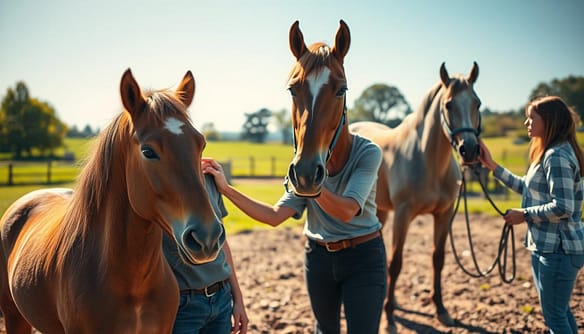
Your tasks are deceptively simple. Practice leading with clear signals. Work on ground manners. Introduce new objects in a process called desensitization. The magic happens in the repetition. An old gelding doesn’t care about your resume. He cares if your body language says “walk here” or “stand there.” He’ll test you, gently. Did you mean to let him drift into your space? He’ll nudge and see. This is where you learn that authority isn’t about force. It’s about consistency.
The table below breaks down the symbiotic learning happening in these sessions. It’s a two-way street of education that benefits both human and horse:
| Skill Practiced by Volunteer | What the Horse Learns/Reinforces | Leadership Development Insight Gained |
|---|---|---|
| Clear leading with rope and body | To follow a confident guide, improving adoptability | Clarity of instruction reduces confusion and builds trust |
| Establishing personal space boundaries | Respect for human space, critical for future owners | Setting boundaries calmly prevents pushback |
| Systematic desensitization to new objects | Confidence in novel situations, reducing fear responses | Gradual exposure builds competence in both parties |
| Reading and responding to subtle equine cues | That communication with humans is effective | Active listening is the foundation of good management |
| Maintaining calm energy during tasks | That humans are predictable and safe partners | Emotional regulation is contagious and stabilizes any team |
This method mirrors effective age-inclusive training principles used in human organizations. You’re leveraging experience. The horse has lifetime knowledge. You have fresh enthusiasm. Together, you create a feedback loop that accelerates leadership development. The retiree isn’t a project to fix. He’s a partner in your education.
The goal is seamless transition. As our Colorado volunteer noted, the aim is to get horses “handled sufficiently to hopefully allow an easy transition to a herd” and ultimately a forever home. You’re not training the horse for today. You’re training him for his next chapter. More importantly, you’re training yourself to be the steady presence any rescue animal needs.
Confidence built here isn’t arrogance. It’s the quiet assurance that comes from successful communication. You asked a 1,200-pound animal to move left with a slight shift of your hip, and he did. That’s power. But it’s power earned through respect, not domination. This is the core of our philosophy: true leadership development makes you a reliable source of information in another being’s world.
When you master the gentle retiree, you’ve passed the first real test. You’ve moved from mechanics to conversation. From following instructions to conducting the orchestra. Then, and only then, are you ready for the complex cases waiting in the next section.
Advanced Care: Medical and Behavioral Issues
Basic horse safety is like Algebra I. But dealing with medical crises and understanding behavior is like advanced calculus. This is our graduate seminar, where we learn to handle complex cases.
You’ve learned to work with a cooperative horse. Now, you’ll meet horses with unique challenges. It’s like moving from general practice to forensic pathology, but with more hay and fewer lab coats.
The medical side requires you to think like a field surgeon with limited resources. We focus on recognizing subtle signs of chronic conditions. Is that slight head-bob a sign of laminitis, or just a fly?
Pharmacology becomes practical, not theoretical. You’ll learn which medications are essential and why. You’ll also observe their effects, getting real-time data from the horse’s response.
Then, we add the behavioral dimension. This is like psychological profiling with hooves. Wolf Hills notes that post-recovery assessment is critical for behavioral and psychological challenges.
Is that weaving a stereotypic behavior born from isolation? Or is it a pain response from a hidden ulcer? The list of common issues in isolated horses is long and disturbing.
- Cribbing: The compulsive chewing on surfaces
- Weaving: The rhythmic swaying of despair
- Wood chewing: Destructive oral fixation
- Pawing, pacing, general anxiety: The restless signatures of trauma
Each behavior is a clue, not a character flaw. A “barn sour” horse might not be stubborn—it might be herd-bound, suffering from separation anxiety.
Consider Handsome Ray, described as “fancy broke” but crippled by buddy-anxiety off it. His isn’t a training problem; it’s a psychological one needing a management strategy.
Your role evolves dramatically here. You’re no longer just a handler. You’re a detective connecting dots between a horse’s physical history and its present behavior. You’re a therapist interpreting actions as communication.
The breakthrough realization? A “problem horse” is usually just a horse with a problem it cannot solve itself. Your job is to become its translator and advocate.
This work separates the hobbyists from the lifers. It’s messy, complex, and occasionally heartbreaking. But when you correctly diagnose a pain-based behavior or successfully manage a psychological issue, you don’t just help a horse. You rewrite its future.
Foster Home Assessment and Matching
This module is like a Swiss watchmaker’s precision and a divorce lawyer’s sharp eye. Sentimentality is left behind. It’s not just about finding a home for a horse. It’s about finding the perfect one.
You become a fierce advocate, not just a caregiver. You learn to evaluate homes with a detailed eye. Every little thing matters. Is their idea of “secure fencing” up to our standards, or is it a risk?
It’s also about understanding that commitment varies. Blaze, needing a companion, is different from Ray, who prefers gentle rides.
We study real cases, like Wolf Hills. Dixie needed an experienced rider, while Ray was great for light rides or companionship. Pumpkin Pie needed an experienced child. Your knowledge from previous modules is key.
Matching a horse isn’t just about the space. It’s about the personality, history, and needs against a family’s lifestyle and skills. You learn to ask tough questions and spot false promises.
Is that “perfect pasture” really safe? Does “we’ve always wanted a horse” mean they’re ready? You must advocate for the horse’s best interests.
The process takes time. Experts say patience is key to finding the right home. The reward isn’t just a quick payment. It’s seeing the horses happy with their new families.
That photo is your success story. It shows your hard work paid off. It’s the final check of the watchmaker’s gear, ensuring happiness for life.
Crisis Response and Emergency Protocols
The Wolf Hills intake model taught us a harsh truth: quarantine first, then assess; stabilize before you diagnose. This isn’t just horsemanship—it’s emergency medicine with hooves. While daily rescue work is like careful diplomacy, crisis response is like battlefield triage for horses.
We prepare for scenarios we hope never happen. Like a colic episode at midnight or a fencing failure during a storm. Or the unthinkable barn fire. Or a severe neglect case, like Dixie Flint, who was on her way to starving.
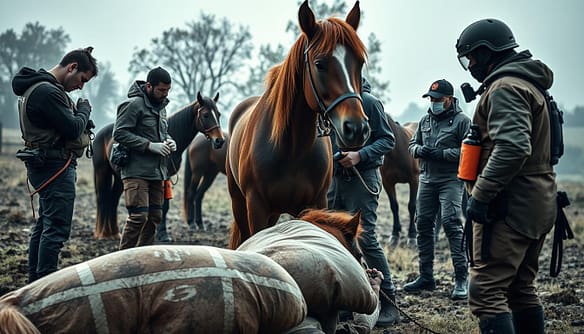
The initial rescue intake is a crisis protocol. You’re not evaluating; you’re stopping the bleeding. This means treating immediate illness, addressing painful rain rot, combating parasites, and managing overgrown feet and teeth. It’s a structured, triage-based approach where seconds are critical.
To turn chaos into tasks, you drill. This module is our mental and procedural fire drill. We teach you to manage your own adrenaline first. You can’t be calm for a panicking animal and humans if you’re flooded with fight-or-flight chemicals.
Different emergencies need different plans. The table below shows how to shift from “Oh no” to “Do this.”
| Emergency Scenario | Immediate Action (First 5 Minutes) | Critical Follow-up (Next 24 Hours) |
|---|---|---|
| Severe Colic Episode | Isolate horse, prevent rolling, call vet with symptoms, monitor vital signs. | Vet assessment, possible transport decision, pain management, hydration monitoring. |
| Catastrophic Fencing Failure | Secure other animals, contain loose horse(s) safely, assess for injuries. | Fence repair, herd re-introduction protocol, injury treatment, stress monitoring. |
| Barn Fire/Smoke | Alert 911, evacuate animals to predetermined safe zones, account for all. | Vet check for smoke inhalation, temporary housing logistics, trauma assessment. |
| Critical Neglect Case Intake | Quarantine, offer warm water, deep bedding, quiet space—no sudden feed. | Comprehensive vet exam, parasite treatment, nutritional plan, hoof care. |
Keeping sharp emergency contact lists and vet coordination channels is key. Who is your on-call vet? Who has the trailer? Who makes the decision if you can’t?
Then there’s the hardest part: the humane euthanasia decision. We talk about it openly, without euphemism. When is it the only merciful option? How do you coordinate it with dignity? This isn’t failure; it’s responsible stewardship when recovery isn’t possible.
This training changes you. You learn to stabilize the situation before chasing a diagnosis. You learn that in a crisis response, your first job is to manage human emotion in the room—starting with your own. Then, and only then, can you effectively execute the emergency protocols that might just save a life.
It’s the least glamorous but most vital skill in rescue leadership. Because when every second counts, you don’t rise to the occasion. You fall back on your training.
Leadership Track Development
Leadership in horse rescue is more than a title. It’s a way of life. If you’ve learned the basics, now it’s time to question them. We’re moving from the what and how to the why.
This module dives into training philosophies. For example, Natural Horsemanship is not just a method. It’s a way of seeing the world. It’s about building trust and communication through understanding and respect, not force.
We compare this to other methods. There’s the traditionalist who values clear hierarchy. And the positive reinforcement expert who uses clickers and treats. We debate and question these methods. Your answers will shape your approach.
The goal is to find your personal “why.” Why do you want to lead? Is it to save more horses or train better? Your “why” guides you when rules don’t apply.
Let’s get practical. How would you plan a six-month retraining for a horse like Micah? You’re not just scheduling vet visits. You’re planning emotional milestones and anticipating setbacks.
Or imagine introducing a spooky horse to trail riding. The old you might follow a checklist. But the leader-you assesses the individual. You break big goals into small, achievable steps.
This track changes you from a technician to a tactician. You learn to read the field, adjust your strategy, and respect your partner’s opinions.
| Leadership Philosophy | Core Principle | Primary Tool | End Goal |
|---|---|---|---|
| Natural Horsemanship | Partnership through communication | Pressure & release, body language | Willing cooperation |
| Traditionalist | Clear hierarchy & respect | Disciplined repetition | Reliable obedience |
| Positive Reinforcement | Motivation through reward | Markers (clicker), treats | Engaged learning |
| Rescue-Based Leadership | Rehabilitation through trust | Patience, tailored plans | Emotional & physical recovery |
The table shows different tools, not just one. A true leader might use structure for safety, then positive reinforcement for new skills. All within a framework of respect.
This module prepares you for more than just running a shift. It prepares you to shape a system. You’ll see the rescue as an ecosystem, not just stalls and schedules.
This is the final leap. From managing cases to leading a vision. It’s messy, nuanced, and essential. The horses who need us most don’t need another person following a manual. They need someone who can write a new chapter.
Graduation Day and Ongoing Support
Graduation in horse rescue is more like getting new keys than throwing a cap. There’s no music like “Pomp and Circumstance.” Instead, you hear the click of a gate opening to a bigger pasture.
Micah, from Colorado, had his graduation day when he moved from a small pen to a big pasture. It wasn’t about finishing something. It was about showing he could handle bigger spaces safely.
We celebrate these moments with pride. But we also know it’s not the end. In rescue, graduation means you’ve earned a new role. You’ve become part of a network.
The support system starts before the gate closes. What does this ongoing support look like? It’s a safety net of knowledge, community, and regular check-ins.
- Foster Home Check-Ins: Placing a horse is not “set it and forget it.” Our team visits regularly. We check on the horse and the foster human, solve problems, and make sure the match works.
- Continuing Education Workshops: Veterinary science and behavior understanding grow. We host workshops on new treatments and techniques. Your initial training is just the start. These sessions keep you updated.
- The “No Shame” Helpline: Got a question at 7 PM on a Tuesday? Our phone tree is ready. Asking for help shows strength, not weakness. It helps us grow together.
Micah and his volunteer didn’t stop at the pasture gate. They started a new chapter of deepening bond and care. The initial training was just the beginning. Their relationship is now their ongoing education.
The key shift we teach is that rescue doesn’t leave you after your time is up. You don’t graduate from the program. You graduate into its heart.
You become a part of a living network. Your experiences help others. Your success informs future workshops. This turns ongoing support into a system you help keep alive.
Yes, we celebrate graduation day. We might even have cookies. But the real ceremony is quieter. It’s when you realize you’re not just a participant. You’re a vital part of the institution, with skills and a community that keeps growing.
Alumni Network and Career Opportunities
So you’ve graduated. What now? The world opens up to you. Your journey from beginner to leader in horse rescue has given you valuable skills. Skills like patience, clear communication, and crisis management are surprisingly useful.
Our volunteer changed careers from the University of Colorado to part-time canine rehab, then to our barn. This shows how adaptable you can be. Your new skills are valuable in many places.
The alumni network is the program’s living legacy. It connects you to real-world jobs. You could work at sanctuaries, veterinary clinics like VCA Animal Hospitals, or therapeutic riding centers like PATH International. Your ability to manage tense situations is useful in many areas.
This network is where you find your next mentor. It’s where you meet a partner for a rescue startup. It’s a group of people who understand your passion for animal care.
You stop being just a volunteer. You become a key part of the ecosystem that saves lives. The training ends. The real work and opportunities are just starting.