
Shelter medicine is a special field of veterinary care. It deals with the health of animals in shelters. The medical ward is the heart of this work.
Here, rules are based on proven animal care standards. These rules affect how diseases spread and how animals get better. The shelters must let animals move and act naturally.
The design of shelters is key, not just the size. It affects how well animals do. Keeping intake areas separate from public spaces helps reduce stress and infection.
The quality of shelters is linked to how long animals stay and their health. The Five Domains model shows this connection. The number of animals and the shelter’s standards both impact health outcomes.
Intake Triage and Vaccination Trees
Shelter intake triage is like a first line of defense. It finds animals that need quick medical help or need to be kept away from others. This quick check happens right when an animal comes in.
The goal is to stop diseases from spreading to the rest of the shelter. This is very important.
During triage, staff do a quick check-up. They look for signs like coughing, runny nose, diarrhea, or being very tired. If an animal shows these signs, it goes straight to a special isolation area.
This fast action is key to keeping everyone healthy.
Keeping new animals separate from others is also very important. This helps stop diseases from spreading. When separate rooms aren’t possible, other ways like using dividers or setting up special times are used.
Studies show that mixing animals from different places increases the risk of getting sick.
After triage, the next step is to give vaccines. This is called a “vaccination tree.” It’s a plan that decides who gets what vaccine based on certain rules.
The rules look at the animal’s type, age, and how it seems to be doing. For example, all healthy dogs get a vaccine against a bad virus right away. Cats get a vaccine to protect against a common cold-like illness.
This way, all new animals get the vaccines they need quickly and consistently.
The main goal is to give animals a quick defense against common and dangerous diseases. Getting vaccines right away doesn’t mean they’re instantly safe. But it’s the best way to make them safer, faster.
This plan, along with careful triage, is the base for all the shelter’s medical work.
Isolation and Biosecurity Design
Modern shelters must have separate areas for diseases like parvovirus and ringworm. This setup is key to keeping animals and people safe. It’s a must for any shelter.
Each disease needs its own space. A parvo ward and ringworm rooms can’t mix. They must be far from where animals live normally. This stops diseases from spreading.
Isolation areas are made to be easy to clean. Floors, walls, and kennels are made of materials that don’t absorb dirt. They also have special drainage to handle waste safely.
Good air flow is also important. Air from these areas goes straight outside. It can’t mix with the air in other parts of the shelter. This keeps the air clean.
Staff follow strict rules to keep things safe. They wear special clothes and use tools only for one area. This helps stop diseases from spreading.
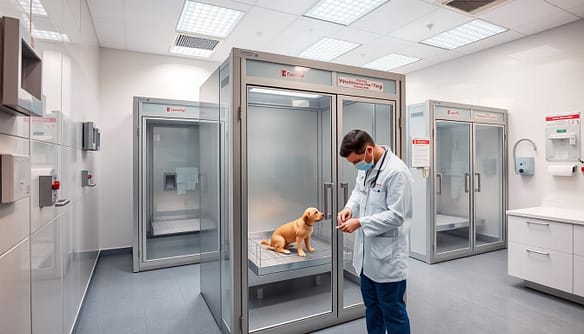
Each disease has its own needs for isolation. The table below shows some of these differences.
| Design and Protocol Feature | Parvo Ward | Ringworm Rooms |
|---|---|---|
| Primary Containment Focus | Fecal-oral viral transmission | Airborne fungal spores and direct contact |
| Critical Surface Type | Nonporous, chemical-resistant for bleach disinfection | Nonporous, easily wiped for antifungal cleaning |
| Ventilation Priority | High; to remove viral particles from air | Very High; to spore-proof the environment |
| Standard Staff PPE | Gloves, gown, boot covers | Gloves, gown, hair cover, sometimes respirator |
| Typical Isolation Duration | Until clinical signs resolve and shedding stops | Until multiple fungal cultures are negative |
Following these rules is very important. It helps keep animals safe and saves resources. For more on shelter medicine, these rules are a key part.
Breed-Specific Risks and Adjusted Protocols
Different dog breeds have unique health risks. In a shelter medicine setting, it’s key to tailor care to each breed’s needs. This approach helps improve health outcomes.
This isn’t about discriminating against certain breeds. It’s about using data to manage health risks. Providing the right care in a safe environment is essential.
Brachycephalic breeds, like English Bulldogs and Pugs, often face breathing problems. Their short noses make them more prone to heat and breathing issues in shelters.
Standard kennels can be dangerous for these dogs. To help, shelters use cooler kennels and provide comfortable resting spots. This helps improve air flow and reduces breathing risks.
These dogs also need less exercise. This helps prevent serious breathing problems in the shelter.
“Bully-type” breeds, such as American Pit Bull Terriers, are more likely to get parvovirus. This virus is a big killer in parvo ward shelters.
These breeds need special care when they come in. Shelters watch closely for any signs of parvovirus. They also isolate these dogs right away.
Shelters quickly give these dogs vaccines. This helps protect them from getting sick.
| Breed Group | Primary Medical Ward Risk | Key Adjusted Protocols | Intended Outcome |
|---|---|---|---|
| Brachycephalic (e.g., Bulldogs, Pugs) | Brachycephalic Obstructive Airway Syndrome (BOAS), Heat Stress | Climate-controlled kennels, Elevated resting platforms, Limited exercise | Prevent respiratory crisis, Reduce stress-induced morbidity |
| Bully-Type Breeds (e.g., Pit Bull Terriers) | Canine Parvovirus Infection | Heightened triage scrutiny, Pre-emptive isolation, Immediate vaccination on intake | Early detection, Contain transmission, Improve survival rates |
The strategies mentioned are based on shelter medicine principles. They show that a one-size-fits-all approach doesn’t work. Each shelter population is unique, and so is their care.
Success in managing a parvo ward or medical ward comes from knowing the risks. By protecting the most vulnerable animals, shelters can make a big difference.
Spay/Neuter Logistics and Pediatric Considerations
Spay and neuter programs are key in high-intake shelters. They control population growth and prepare animals for adoption. Efficient logistics are vital for animal health and managing shelter space.
Planning starts with scheduling. Surgical days are set based on intake and vet staff. A clear process moves animals from prep to surgery and recovery. This reduces stress and wait times.
Anesthesia choices are made for high-volume settings. Injectable or gas anesthesia is picked based on species, breed, and age. Recovery rooms are warm and quiet for monitoring. Staff check vital signs often during the first recovery phase.

Pediatric spay/neuter needs special rules. Studies show early sterilization is safe for kittens and puppies. They must be at least eight weeks old and two pounds.
Young animals need special housing. It should have separate areas for sleeping and elimination. Multi-compartment units are best for pre- and post-operative care. This design helps reduce stress and keeps areas clean.
| Parameter | Pediatric Animal | Adult Animal | Key Considerations |
|---|---|---|---|
| Minimum Age | 8 weeks | Typically 4-6 months | Pediatric surgery requires precise weight monitoring. |
| Minimum Weight | 2 lbs (0.9 kg) | Varies by breed | Weight is a safer criterion than age alone. |
| Anesthetic Protocol | Lower dose, fast-metabolizing agents | Standard doses based on weight | Pediatric patients are more sensitive to anesthesia. |
| Recovery Housing | Multi-compartment unit required | Standard single kennel often sufficient | Juveniles need separated spaces for rest and elimination. |
| Post-Op Monitoring | Every 15-30 minutes initially | Every 30-60 minutes initially | Young animals can hypothermize quickly after surgery. |
Good spay/neuter logistics help animals leave shelters faster. A study shows that housing must match adoption capacity. Keeping animals too long harms their welfare. The goal is to quickly move them to adoption floors.
Shelters must match surgery volume with adoption capacity. Doing surgeries without a plan for adoption creates a bottleneck. The aim is to smoothly move animals from medical care to their forever homes. This approach improves outcomes for each animal.
Data Tracking: Morbidity/Mortality and Length of Stay
A mathematical model shows a clear link between shelter size, stay time, and disease rates. In shelter medicine, tracking data is key for making good decisions. It turns guesses into real numbers for planning.
Three main metrics are used for analysis. Morbidity is the illness rate. Mortality is the death rate. Length of Stay (LOS) is how long animals stay before being adopted.
Studies show a strong link between these numbers. If a shelter has more animals, they stay longer on average. This longer stay increases disease risk and uses more resources.
Longer stays mean more chance of getting sick and weaker immune systems. This raises the illness rate. It also puts a strain on medical supplies, staff, and space. The data clearly shows managing intake is key to medical care.
Tracking these metrics helps shelters prevent problems instead of just reacting. This systematic analysis has several important uses:
- Early Outbreak Identification: Sudden increases in illness data warn of outbreaks early.
- Protocol Efficacy Evaluation: Comparing death rates before and after new treatments shows their effect.
- Evidence-Based Resource Allocation: High LOS for certain animals shows where to improve adoption or medical care.
- Objective Population Management: Data helps decide who to take in and when to send animals to other shelters.
This method is vital for improving shelter medicine. It gives the proof needed for making changes and getting more resources. Good data tracking is key for better outcomes, a main goal of modern shelter work. It ensures animal care decisions are based on facts, not just feelings.
Cost Models and Partnerships with Clinics
Sustainable shelter medicine needs clear financial plans and partnerships. The budget decides how much care a ward can give. Without a good plan, even the best systems can fail.
Starting with a budget for each animal is key. This budget covers basic care like shots and meds. It also has money for surprises, like parvovirus in certain dogs.
Approved drug lists help control costs. These lists make sure care is consistent and affordable. They help get the best treatments at a low cost.
Grants are a big help. Shelters get money for special projects, like spay/neuter programs. This money helps without hurting the regular budget.
Working with private vets is essential. They often give free or low-cost help. This lets shelters handle tough cases and do more surgeries.
Teaming up with vet schools is also good. Students learn on the job, and shelters get more help. This is key for shelter medicine in many places.
Spay/neuter groups are important partners too. They focus on sterilization, freeing up shelter staff for sick animals.
The table below shows main partnership types and their benefits.
| Partner Type | Primary Contribution | Impact on Shelter Operations |
|---|---|---|
| Private Veterinary Clinic | Surgical support, complex case transfer | Reduces surgical backlog, manages severe cases |
| Veterinary School/University | Student labor, advanced diagnostics | Increases veterinary capacity, provides cost-effective diagnostics |
| Non-Profit Spay/Neuter Organization | High-volume sterilization services | Frees internal resources for medical treatment |
These partnerships turn a shelter into a community health center. Clear budgets help plan for the future. Together, they keep animal care high without running out of money.
Good economics and teamwork are what shelter medicine is about today. They help keep animals healthy and meet their needs. This is the base for all care, from start to finish.
Case Studies: Outbreak Response and Recovery
A canine parvovirus outbreak at a municipal shelter tested its isolation protocols. This real-world scenario, along with a fungal infection incident, shows the importance of structured shelter medicine responses.
The parvovirus incident started with a single symptomatic puppy. The staff noticed lethargy and anorexia. They quickly isolated the puppy and ran a diagnostic test.
The test showed a positive result, so the shelter’s parvo ward protocol was activated. This protocol included suspending intake and tracing contacts. Three exposed puppies were moved to the parvo ward.
The treatment for the puppies was intensive. They got intravenous fluids, anti-nausea medication, antibiotics, and plasma transfusions. The outbreak was contained, and no animals outside the ward got sick. Eighty-five percent of the puppies recovered.
The shelter reopened after a 14-day quarantine and a thorough clean. A second case involved a ringworm outbreak in the cat colony. The diagnosis came from Wood’s lamp examination and fungal culture.
To manage the outbreak, dedicated ringworm rooms were set up. These rooms had HEPA filtration and were cleaned daily with a fungicide. Infected cats got lime sulfur dips and antifungal medication. Staff wore full protective gear.
The protocol required two negative fungal cultures, one week apart, to declare an animal cured. This careful follow-up ensured no hidden cases were missed. The outbreak lasted 42 days, and all infected cats recovered without spreading the fungus.
These events led to changes in the shelter’s protocols. The parvovirus response showed the need for quick action when animals show signs of poor health. Delaying isolation can harm many animals.
The ringworm management highlighted the importance of having ringworm rooms ready. This preparedness helps contain outbreaks quickly. Both cases prove that well-planned medical ward protocols can control outbreaks and improve animal health.
How Donors and Volunteers Help
Shelters need community help to care for animals. Donations buy vaccines, meds, and supplies. This money also gets them the tools they need to keep animals safe.
Volunteers play a big role too. They help animals feel better by playing with them and giving them a home. This helps animals get healthier and happier.
Volunteers also help with important tasks like keeping records and helping animals find homes. This lets the vet team focus on what they do best: healing animals.
Donors and volunteers are key to a shelter’s success. Together, they make sure animals get the care they need. This teamwork leads to better lives for animals in shelters.